Sunday, January 25, 2015

Time Magazine's Top 100 Young Adult Books


Greetings!
As is often the way of the world, whenever I turn my attention to particular topic, I suddenly see it everywhere, in the most random places, when least expected. It is delightful, and also not very surprising, since, well, I'm paying attention to it. To paraphrase Sherlock, I often see, but fail to observe. Once I start observing, I find lots of things around me that are suddenly full of meaning and importance.

Since I have recently been writing about books I read when I was younger, I was pleased that Time magazine did a story just for me about the Top 100 young adult and children's books of all time (in the first issue of 2015). In fact, Time even had a blurb from author Jesmyn Ward who said that Robin McKinley's The Hero and the Crown (prequel to The Blue Sword) was her favorite book as a child! To quote Ward, "The heroine [in The Hero and the Crown] is tough, stubborn, and smart, taking on a world bent on making her less than she is. I empathized." What excellent taste she has!

Enjoy browsing these lists. I was surprised at the number of books I hadn't read, pleased with the ones they chose that I had read, and disagreed about surprisingly few of them. I was also reminded of a few books I had forgotten I'd read (Johnny Tremain anyone? Loved that book!).

Here are the links:

Top 100 Young Adult Books of All Time

Top 100 Children's Books of All Time

I'd love to hear your thoughts when you are done looking at the lists. Any surprises? Remind you of any of your favorite books? Any that you think really shouldn't be on this list?

Saturday, January 17, 2015

Pride and Prejudice: My first time

When I was a child, my method for choosing what to read was to go to the library and read every book by an author that I already knew I liked.

Obviously, this was a flawed method because I ran out of books pretty quickly.

If I wasn't already familiar with an author, I approached a new book like I might a strange dog. I would look at it carefully. I would read the back of the book, the inside flap, maybe scan a few pages, ready to drop it and run at the slightest sign of something I didn't like. I had to get a feel for the book, and it had to feel right. Otherwise I wouldn't read it. I turned away from the tawdry romances with their ubiquitous shirtless Fabios, and the garish covers of mystery novels, usually sporting some kind of intriguing trinket on a purple cover with yellow text, and many of the juvenile contemporary young adult novels that showed a photograph of a depressed teenager. I knew these were not the books for me; they didn't feel right. I wasn't interested in them - I felt I already knew all their secrets. Or that their secrets weren't worth knowing.

But if I was ever going to find new authors, risks had to be taken. I still remember the first Jane Austen novel I read. Inadvertently, I began with her most popular work, Pride and Prejudice. The copy I stumbled across was a red book, with gold lettering, the kind that comes in those fancy library collections where all the books match. I know it came from a collection such as this because the book was at my grandparents house, buried amidst other classics like Don Quixote and War and Peace.

I was probably only twelve at the time, though that sounds young, I couldn't have been much older because my mom was pregnant with my younger sister and my older sister and I had been sent to stay at my grandparents house for two weeks because we'd been exposed to the chicken pox and had to be sent away since my mother had never had them.

I can't stress how bored I was. So. Bored. It wasn't my grandparents' fault. They were enjoying their retirement and hadn't had kids around in years. They had a strict routine that involved working out before the sun was up, eating small portions of vegetables and cottage cheese, and falling asleep on the couch at 7 pm watching PBS.

I could have read any of the books on that shelf and I don't remember why I chose to look at Pride and Prejudice. Deprived of any picture on the front, any writing on the back cover, and no book jacket with helpful hints, I didn't have much to go on. I opened it and read a few lines. And didn't put it down. I remember a few chapters later thinking, How did I not know about this book or this author? By that time my father had already read us a few Dickens' novels, Tolkien, C.S. Lewis, and Wilke Collins, so it was a genuine question.

The wonderful thing about reading Pride and Prejudice so young was that I was truly taken in by the novel. When Darcy proposed to Elizabeth I was shocked. I hated him; I'd even pictured him like one of my classic ugly bad guys. Kind of like Gaston. Then when Elizabeth started falling for him I was gradually won over. I'm pretty sure I stopped reading and mentally changed his appearance to be more fitting of his new role as lead man.

That first read, I really experienced Darcy the way Elizabeth did. I'm not sure many people get to experience Pride and Prejudice like that, because most people know all about it before they read it and because most people bring some amount of maturity to the book and aren't fooled when Elizabeth despises him. If I read the book now, I know I would have identified Darcy right off the bat as the guy. After all, he was the richest and Austen, I learned later as I devoured all 6 and a half of her books, is all about the happy endings.

What about you? Did you know Darcy was the guy right from the beginning? Were you fooled along with Elizabeth? When did you first read the book?

Wednesday, January 14, 2015

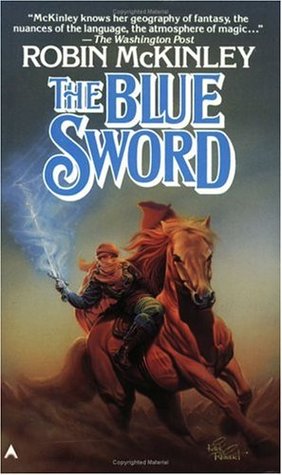
The Blue Sword

I discovered Robin McKinley when my dad read us her book The Outlaws of Sherwood, a pragmatic and slightly depressing retelling of the Robin Hood legend. I remember attempting to read a few of her other books and not falling in love with them really, until I read The Blue Sword

The Blue Sword is about a girl named Harry. That’s right - a girl. You love it already don’t you? I couldn’t tell you why her name is Harry, even though I’ve read the book several times. I think it is a nick name. Harry is forced to move to a new town when her father dies, a town that is essentially a military outpost and is on the edge of a vast desert, home to a strange and foreign people. Harry is inadvertently swept up in a war between these foreigners and their long-time enemies. 

Spoiler alert: She gets a blue sword.

If you’ve been reading my blog posts about the books I loved as a child, you will no doubt notice a theme when I say that I loved Harry because she wasn’t proper and well-behaved. She preferred horseback riding to sitting daintily in a parlor and not to give anything away, she kicks some pretty serious keister by the end of the book.

This book fits squarely in the fantasy genre and is technically young adult, but McKinley is a talented author, so it is young adult I think mainly because it doesn’t have cursing, sex, and violence or other mature content.


If you don’t love fantasy, you might not enjoy this book. It’s fairly traditional in it’s fantastical elements and plot. If you do love fantasy, you will enjoy McKinley’s world building and the development of Harry’s character.

Wednesday, January 7, 2015

BabyLit books

BabyLit books are adorable, delightful books that make literature accessible for very small children. Or maybe they just make it more fun for literature-loving adults when they read these books to their little ones. Either way, I highly recommend this series.


I didn't read these books when I was a baby, so this post is a bit off-topic. However, my small one has many of these (thanks to many of my wonderful friends and family!) and I love reading them to her.  So some day, these books will be on a list of books she read as a child.

The books don't necessarily tell the stories they are named after; instead, they are a collection of "primers" (sound primer, opposites primer, ocean primer, etc...) so little ones can learn while they read. But there is often subtle humor included in the text or drawings for adults who have read the stories, or sometimes beautiful quotes.

I promise these will be a huge hit at the next baby shower you attend. Or the next time you snuggle up to read a bedtime story to your toddler. You can buy them on Amazon or on the BabyLit website.

Wednesday, December 31, 2014

The Ordinary Princess

Despite my last post, I didn’t realize how personal it could be to write about favorite childhood books until I sat down to write this post. It’s hard to explain why you loved a book as a child without dredging up childhood insecurities and idiosyncrasies.

So here you are: a book recommendation and a healthy dose of self-deprecation.

One of my favorite books growing up was The Ordinary Princess by M.M.Kaye. I got it from the library and had one of those magical experiences where the book was everything I wanted it to be and more.

Two things you should know about this book:
1. It has beautiful illustrations (see above).
2. The prose is charming.

Why did I love this book as a child? I loved this book because it is all about an ordinary princess.  I had quite the ugly duckling complex as a child. I really didn't think much of my physical appearance. I felt like my older sister was the “pretty one” and I was the “smart one.” Who knows if I made this up in my head or picked this up from the small comments adults make in passing that children end up keeping in the deepest places of their hearts? But however it was that I ended up with this complex, I was enamored with Princess Amy because all of her sisters were beautiful and she was not. 

She tore her dresses and got freckles from sitting out in the sun. 

She had mousy hair. 

She was clumsy.

And she was special. Even though she wasn’t pretty and didn’t behave like a proper princess, she had a grand adventure and eventually found love, someone who thought she was beautiful just the way she was, inside and out.


I suspect that I am not the only little girl in the world to feel unattractive and unfeminine. I think my complex was and is far more universal than my solipsistic little self realized at the time. With that in mind, I highly recommend this classic tale of the conflict between inner and outer beauty, social and personal expectations, and the need for acceptance. It is an excellent book for ordinary princesses of all ages.

Monday, December 29, 2014

Books We Read as Children, Part One

When you read a book as a child, it becomes a part of your identity in a way that no other reading in your whole life does.” Kathleen Kelly, You’ve Got Mail

If you want animated conversation with a reader, ask them what books they read as a child. Invariably, their face will light up as they chronicle the books they read when they were young - sometimes completely random books that you’ve never heard of, other times classic stories that you remember reading as well.

Mind, this only works for people who have been readers from a young age. Ask the average freshman what they read when they were kids and they will stare at you blankly and mutter something about Dr. Seuss (a very good writer, I must add).

There are three strange things about favorite childhood books:

1: The books that one person claims are phenomenal, one of their favorites from childhood, a classic, are oftentimes books not many other people recognize.
2: These books will be vehemently defended by these people as wonderful books, even when other people, who are adults, read them and fail to see many (or any) redeeming qualities.
3: Therefore, it can be inferred there is some kind of magical bond that occurs when one is young and falling in love with a book, and that due to this bond, quality does not matter. 

I’m sure you have your own books that you love and reread now as an adult with fond sentimentality. For me, these books are The Blue Castle, The Blue Sword (no, these aren’t part of a series and are in two completely different genres), and The Ordinary Princess, among others.

Note my obvious penchant for novels with blue in the title.

Anyway, I recently read The Blue Castle to my husband. He agreed that it was funny, but told me, “it’s pretty much a romance.”
“No, it’s not,” I defended angrily. “It’s so funny, and it’s really about how the character changes and gets her dream life and doesn’t let her family control her any more…” my voice trailed away while my husband waited patiently.  A pause. “Okay, it’s a romance.”

The truth is, The Blue Castle, written by L.M. Montgomery, beloved author of Anne of Green Gables, is more or less a young adult romance. But to me it was so much more. When I read it as a child, the main character reminded me of the way I could be sometimes: timid, easily cowed, submissive to a fault, and dissatisfied with her life (most teens are dissatisfied with their life at one time or another). Then the character changes. She becomes bold and goes after the life she wants. That was inspiring to me as a child, and still is, really. That book became a reminder of all that I was capable of doing.

So when I read it again, and again, and again as an adult, I didn’t necessarily see the framework of any particular genre; I saw the girl I was when I first read it, remembered how I responded to it the first time I finished it (the ending is just delightful). I saw past me and present me and future me in that slim little book. I saw the flaws I struggled with then, the weaknesses I still struggle with, and all that I’ve overcome.

Years ago, a friend asked me a question dreaded by all book lovers:

“What is your favorite book?”

Groan. He noticed my dismay and quickly added, “What book do you find yourself rereading over and over?”

I’m a fairly private person and so I’m still surprised that I didn’t answer vaguely or give some scholarly answer like “Jane Austen books.” I think part of me didn't want to make myself appear more scholarly than I actually am. I was an English major and love classic authors like Dickens and Twain, so it would have been easy to put on a facade of sophistication - twirling my non-existent mustache and saying, “well it’s a toss up between Shakespeare’s Hamlet and Dickens’ Great Expectations, my good man.”

But it wasn’t true. In a moment of unexpected honesty, I replied, “The Blue Castle by L.M. Montgomery.”

My friend raised an eyebrow. “Really? That surprises me,” he said, rather unnecessarily. Then he got pulled away by someone and I was left feeling a bit deflated.

The truth is, everyone is a bit surprised by the books that have the most profound impact on other people because, to quote Edmund Wilson, “no two persons ever read the same book.” No matter how close you are to a friend or family member, you might not always fully understand why they have a bond with their favorite books. 

Why those books spoke into their life in a quiet way.

Why they saw in that book a mirror, or a vision, or a dream.

So as much as I love to discuss books and recommend books and read books that my friends are reading, I know deep down that there is a part of my reading experience that is only mine. 

Which is quite possibly the reason I keep reading.

***********

Over the next few days and weeks I'm going to venture back into the dusty cobwebs of the books I loved as a child and share them with you on this blog. I'd love to hear in the comments what some of your favorites were as a child.


Friday, December 26, 2014

A bookmark without a home

Today I finished Assassin's Apprentice, the first book of a fantasy series written by Robin Hobb. It was a fantastic finale, a nail-biter to the end, and I teared up in just the last few sentences.

Once I closed the book, I noticed my bookmark, sitting there on the couch...and I had no idea what to do with it. Where do you store a bookmark if not in a book? I am one of those people who has to have a place for everything, so this was a serious problem. I didn't want it on my nightstand, it didn't feel right in my drawer with my notebook and Bible, it couldn't just sit out on top of a random book.

It was quite the conundrum. I finally just decided I'd have to start another book immediately so I'd have a place to keep it.

But now I want to know: Where do you store your bookmarks?

That way I can have a backup plan in case my bookmark becomes homeless again.