Showing posts with label Book Review. Show all posts

Thursday, April 2, 2015

Book Review: Bringing Up Bebe by Pamela Druckerman

Bringing Up Bebe is written by an American mother living in France. She is intrigued by the difference in behavior between French and American children (read: American kids throw their food and French kids don't) and begins investigating French parenting. This book is about her discoveries.

The last thing many moms want to do is read a dry, preachy parenting book during nap time. The few nuggets of wisdom aren't worth the horrible guilt, self-judgement, and overanalyzing. Also, I like to think that underneath the supermom exterior there is a real human being who might just want to read something that isn't about sippy cups and sleep training.

But I heartily recommend this book to all moms - and less heartily I recommend it to those who aren't moms, because it is that interesting and well written...though it may not be as funny for you. Unless you find power struggles with beings one quarter of your size amusing.

This book is far from preachy and - best of all - it is hilarious. Well-written, self-deprecating, honest, and anecdotal, I found myself wanting to read this book. I tore through it in about two days (usually reading while I was nursing).

My favorite thing about this book though is that it opened my eyes to how cultural our ideas of parenting are. Most of what I took for granted as some universal agreement about what a good mother looks like is actually unique to us Americans. It took a lot of pressure off of me to be this so-called perfect mother. Realizing that the perfect mother looks very, very different in other cultures revealed that maybe there isn't a perfect mother. Maybe all these things that I felt like I had to do (go on playdates; go to story time; breastfeed my child; stay at home; alternately work a billion hours and look like I do it with ease; prep my child for college at the age of one; never take care of myself - always the baby first!) were actually just cultural ideals that I could reject, not a solemn, ethical parenting code.

There may be some moments in the book where French parenting is a bit idealized. But I can't really blame the author for this when babies in France magically sleep through the night around 3 months for no reason that French parents can recall other than that the moms had to return to work and "the baby knew mom needed her sleep." Meanwhile, American parents are still sleep deprived several months after the baby is born and often past baby's first year.

Maybe somehow our parenting ideals are working against us? After reading this book, as well as All Joy and No Fun, I'm starting to think that may be the case. And while I have no intention of making any sweeping claims about the right way to parent (I really don't believe there is one right way), I do intend to go easy on myself and let myself parent the best I can, sans cultural commentary.


Tuesday, February 24, 2015

An Update in Reading

This month has been so busy that routine, along with all of the wonderful things that routine maintains including laundry and blog posting, has disappeared from my life completely.
Not surprisingly, I've still managed to read a few books. Because that's the second to the last thing to go (the last thing would obviously be breathing).
So here is a quick survey of my reading last month:

The Sandman: Preludes and Nocturnes, 4 stars. This is the first comic book/graphic novel that I've ever read! Reading comic books is difficult for me. My mind keeps trying to create the setting, the mood, to draw the characters and it gropes for information about these details - "Why is there so much dialogue! Why won't they stop and tell me where they are and what the air smells like and what the weather is doing?" Then I remember that it's all in a picture behind the words. So weird. But eventually I got into a good rhythm and didn't have to remind myself to slow down and look at the pictures. When I finished this collection, I had a few thoughts: That was a weird place to stop the story. Holy cannoli that was gruesome and creepy. There might have been a few sections that were pure genius. I wasn't instantly enthusiastic about it. I had to let it stew in my brain. I had to strain out the gruesome (I'm not prudish usually about violence, but for some reason, probably since there were pictures, it creeped me out) and absorb the great. Because there were two issues (I think they are called issues?) that Blew. My. Mind. One of them was an issue that switches to the point of view of a very minor character, a waitress at a diner who is a writer. She sees her customers as fuel for her writing. That's all I will say, but if you only read one issue, that would be the one to read. Neil Gaiman is extraordinary. If I was still teaching, I would seriously consider adding a lesson where we analyzed one or two issues of this text.

Anne of Green Gables, 5 billion stars. (The exaggeration is in in honor of Anne, of course.) I never realized that L.M. Montgomery was one of my favorite authors until a week ago. I got a sudden urge to reread Anne of Green Gables and now all I want to do is read Anne of Green Gables or watch Anne of Green Gables. Also, I plan on moving to Prince Edward Island. Seriously. My husband said he would do it.

Carry On Warrior, 3 stars. I can't enjoy nonfiction as much as fiction and so I always find it difficult to rate and recommend and talk about at all. Also, I have a weird voice in my head that is super judgmental when I read nonfiction. I haven't the slightest idea why. Anyway, this book was pretty hilarious, especially the anecdotes about the author and her children. I know it's cliche of me to enjoy reading about how a child threw a temper tantrum at Target just because I too may one day get to experience that joy, but what can I say, it's funnier on this side of things. The author of this text, Glennon Doyle Melton, is well known for her brutal honesty. I found this very refreshing and challenging. Sure, she had some ideas that were strange and that I disagreed with (which the voice in my head demands that I tell you), but I'd totally be friends with her. I read a review on Goodreads that said the prose was terrible. It wasn't. It was really funny. It was blog-prose or thinking-out-loud prose. But it worked for the book stylistically.

What are you reading currently?

Wednesday, January 14, 2015

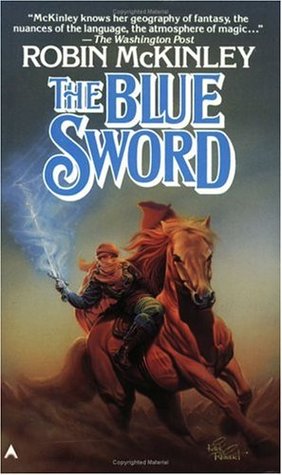
The Blue Sword

I discovered Robin McKinley when my dad read us her book The Outlaws of Sherwood, a pragmatic and slightly depressing retelling of the Robin Hood legend. I remember attempting to read a few of her other books and not falling in love with them really, until I read The Blue Sword. 

The Blue Sword is about a girl named Harry. That’s right - a girl. You love it already don’t you? I couldn’t tell you why her name is Harry, even though I’ve read the book several times. I think it is a nick name. Harry is forced to move to a new town when her father dies, a town that is essentially a military outpost and is on the edge of a vast desert, home to a strange and foreign people. Harry is inadvertently swept up in a war between these foreigners and their long-time enemies. 

Spoiler alert: She gets a blue sword.

If you’ve been reading my blog posts about the books I loved as a child, you will no doubt notice a theme when I say that I loved Harry because she wasn’t proper and well-behaved. She preferred horseback riding to sitting daintily in a parlor and not to give anything away, she kicks some pretty serious keister by the end of the book.

This book fits squarely in the fantasy genre and is technically young adult, but McKinley is a talented author, so it is young adult I think mainly because it doesn’t have cursing, sex, and violence or other mature content.


If you don’t love fantasy, you might not enjoy this book. It’s fairly traditional in it’s fantastical elements and plot. If you do love fantasy, you will enjoy McKinley’s world building and the development of Harry’s character.

Wednesday, January 7, 2015

BabyLit books

BabyLit books are adorable, delightful books that make literature accessible for very small children. Or maybe they just make it more fun for literature-loving adults when they read these books to their little ones. Either way, I highly recommend this series.


I didn't read these books when I was a baby, so this post is a bit off-topic. However, my small one has many of these (thanks to many of my wonderful friends and family!) and I love reading them to her.  So some day, these books will be on a list of books she read as a child.

The books don't necessarily tell the stories they are named after; instead, they are a collection of "primers" (sound primer, opposites primer, ocean primer, etc...) so little ones can learn while they read. But there is often subtle humor included in the text or drawings for adults who have read the stories, or sometimes beautiful quotes.

I promise these will be a huge hit at the next baby shower you attend. Or the next time you snuggle up to read a bedtime story to your toddler. You can buy them on Amazon or on the BabyLit website.

Wednesday, December 31, 2014

The Ordinary Princess

Despite my last post, I didn’t realize how personal it could be to write about favorite childhood books until I sat down to write this post. It’s hard to explain why you loved a book as a child without dredging up childhood insecurities and idiosyncrasies.

So here you are: a book recommendation and a healthy dose of self-deprecation.

One of my favorite books growing up was The Ordinary Princess by M.M.Kaye. I got it from the library and had one of those magical experiences where the book was everything I wanted it to be and more.

Two things you should know about this book:
1. It has beautiful illustrations (see above).
2. The prose is charming.

Why did I love this book as a child? I loved this book because it is all about an ordinary princess.  I had quite the ugly duckling complex as a child. I really didn't think much of my physical appearance. I felt like my older sister was the “pretty one” and I was the “smart one.” Who knows if I made this up in my head or picked this up from the small comments adults make in passing that children end up keeping in the deepest places of their hearts? But however it was that I ended up with this complex, I was enamored with Princess Amy because all of her sisters were beautiful and she was not. 

She tore her dresses and got freckles from sitting out in the sun. 

She had mousy hair. 

She was clumsy.

And she was special. Even though she wasn’t pretty and didn’t behave like a proper princess, she had a grand adventure and eventually found love, someone who thought she was beautiful just the way she was, inside and out.


I suspect that I am not the only little girl in the world to feel unattractive and unfeminine. I think my complex was and is far more universal than my solipsistic little self realized at the time. With that in mind, I highly recommend this classic tale of the conflict between inner and outer beauty, social and personal expectations, and the need for acceptance. It is an excellent book for ordinary princesses of all ages.

Sunday, September 28, 2014

Book Review of A Series of Unfortunate Events

I love these books. If I were a kid, I would give these books 5 out of 5 stars. Since I am an adult, they were a bit too easy of a read for e to give them 5 stars. For some reason, that is how my brain works.

What I love about these books is that they are witty. It is rare to find children's books that rely on wit for their humor instead of situational comedy. 

The characters are two-dimensional, the plot isn't complex; it is simply a story of orphans (each with an assigned character trait: one is smart and reads, one is smart and builds things, one is smart and bites things) who are running from an evil man (who is horribly, overtly evil for no other reason than that he is evil) who wants their money. But the fact that the story is overly simple doesn't matter because the narrator/author Lemony Snicket is sly and witty and amusing and doleful. 

Plain and simple plot. Witty narrator. Hilarious stories.

Saturday, October 12, 2013

Book Review: Ender’s Game By Orson Scott Card

Three things you need to know about this book:

 1. The protagonist is a 6 year old child (it starts when he is 6) who is quite possibly wiser than I am.    
 2. I would categorize this book as epic science fiction. Because it’s epic.
3. This book is action-packed, but still has room for moments that make you want to cry. It deals with some mature themes - some of which might be lost on a younger audience. Watch out though. As soon as you start getting choked up, strap in, because the next thing you know you will be following an epic and incredibly intelligent battle game, all tears forgotten.

Plot synopsis that in no way does the story justice:
Ender is chosen to go to Battle School, a school for genius children to train for battle (who would’ve guessed?). What Ender doesn’t know, at first, is that he was chosen as mankind’s last hope to save earth from the buggers (aliens) – if he can survive the training and achieve his potential.

What I loved about this book:
Ender. He is smart – a genius – and often lonely. He is compassionate and ruthless at the same time. He doubts himself, growing in some incredible ways, and yet in other areas, stubbornly refusing to see things the way they are, or to grow or change at all – something that is profoundly true to life.

The battles. I can’t explain them, you just need to read them. Ender’s brain works out intelligent battle plans, sometimes in-the-moment. I was frequently astonished at the lucidity of his choices and the way he viewed things differently than others – something that caused his battle plans to be creative and surprisingly effective. Few authors can describe a battle and keep me interested. (Sorry, I know that is maybe girly of me, but I get bored with troop movements. Maybe that is why I never play Risk.) To date, there are only a few authors who have captured my interest in this area:  J.R.R. Tolkien is one; Orson Scott Card is another.

I’m a cynic at heart. I really am. I’m not all in-your-face about it like I was when I was a teenager, but I’m still very cynical deep inside (I just call it practicality now). This book appealed to the cynic within me. I can’t say more without giving important plot points away, but if you too like cold harsh reality (of made -up future worlds of course – not really real cold harsh reality) then you will appreciate this book.

I would recommend this book to children in middle school all the way up to adults of all ages.Younger kids wouldn't really be able to follow the plot, which is somewhat complex. There is some violence, but overall Card delivers a beautifully complex message about violence and war.

Friday, July 26, 2013

Would you like a cocktail to go with your literature?

A friend bought this book for me as a thank you for watching her dog and I just had to share this. It is both amusing and instructive, while simultaneously answering two questions:

What cocktail should I make? 
and 
What book should I read?

And let's face it: haven't we all struggled with both of those questions from time to time? In case you couldn't tell by the title, this book is a recipe book for cocktails, but each cocktail is named after famous novels (mostly literary, but there are a few popular fiction titles mixed in).

The book is the perfect size to stash on the top of your bar, has lovely vintage illustrations, and includes drinking games both for when you are alone: "Slam a Red Bull every time you turn the page in Wuthering Heights. Just to stay awake, actually" (Federle 134) and with friends: "Smuggle booze into a library. Pull book titles out of the card catalog at random, playing 'Never have I ever' with the classics - 'Never have I ever read The Great Gatsby,' etc... All who have read the book in question must take a swig from the bottle. Scholars get smashed" (Federle 135).

I am not going to give away all of the wonderful and hilarious delights of this book, mainly because I don't want to infringe on copyright and I also might buy this book for everyone I know for Christmas. But if you want more, here is a link to amazon for you, where you too can purchase and enjoy this treasure.

I will leave with a parting gift: a list of my favorite cocktails from the book (based on their name, anyway, I just got it yesterday so I haven't made them all yet).

5. Lord Pimm
4. Are you there God? It's me, Margarita
3. Rye and Prejudice
2. Paradise Sauced
1. A Cocktail of Two Cities

Enjoy!

Tuesday, July 23, 2013

Book Review: Boneshaker By Cherie Priest

Time for a book review!
I recently finished reading Boneshaker, Cherie Priest's first book in her Clockwork Century series.

Three things you need to know about this book:
1: There are zombies.
2: It takes place in an alternate history steampunk universe.
3: It is over-the-top in a very good way.

I could just stop right there couldn't I? You are already so curious that you are probably going to go read the book right now. But just in case you want a little bit more...

I hate summarizing plots. Often, kind-hearted people who try to take an interest in what I am reading ask me, "What is your book about?" To which I give a grumbling reply, "Why don't you read it and find out." But as I understand it, it is common for book reviews to explain a little bit of what the book is about. So here you go:

The story is set in the late 1800's, during a prolonged Civil War (remember what I said about alternate history?). The story begins with a mad scientist, Leviticus Blue, who invents a machine (three guesses what it's called) that can drill through thick layers of ice for gold in Alaska. Something goes terribly wrong and the machine is set loose in Seattle. It cuts so deep into the earth that it strikes a vein of some gaseous substance - called the Blight - which begins killing people and then eventually turning some people into the living dead. The area is obviously evacuated and people rebuild their lives outside of the walled-in, blight-infested area of Seattle. Then one day, the mad scientist's 16 year old son, Ezekiel Blue, decides to enter Seattle in search of answers. After learning where he has gone, his mother, Briar Wilkes, must follow him into downtown Seattle and battle zombies as she attempts to save her son.

That plot synopsis really didn't do it justice, but you get the idea. I gave this book 4 out of 5 stars on Goodreads.
I loved reading this book for two reasons. First, it was very refreshing to read about a heroine who wasn't 18 years old and in love with two boys. Briar Wilkes is a passionate, no-nonsense kind of woman who cares about her son and will do anything to save him. She is also somewhere around 30, so her thought process and the choices she makes are more focused and mature.
Second, I love the world Priest built. She went steampunk with complete abandon. Even the character's names are delightful. There are pirates in airships, cool gadgets, a female bartender with a mechanical arm. Lots of fun.

My one complaint about the book is towards the end, she kind of lost me. I usually read the end of books ravenously, barely stopping to do anything, but this one I took my time with. I think it was a bit anti-climactic and I think something happened with the prose. All I know is I would be reading and instead of words clicking together and making sense, they were awkwardly phrased; the descriptions didn't seem to match what was going on. This might be the fault of the reader, not the writer, and the rest of the book I found her prose very refreshing and original.

Overall, I recommend this book to anyone who likes zombies and/or steampunk and/or strong female protagonists (she and Zeke are both protagonists in this story though - it is third person, but switches back and forth between the two characters).

Side note: If you aren't familiar with steampunk, google it. It is rather beyond my powers of explanation, though if I may steal the words of a representative of the Steampunk Society at Comicon, one of the best descriptions is that it is Victorian science fiction.