Thursday, March 17, 2016

G.K. Chesterton....Enough Said.


Credit: Patheos.com and Google Images
Not really. It's not really enough to just say G.K. Chesterton's name, though it should be, because everyone should know about his writing and everyone should read it (more than just his quotes on Goodreads and Pinterest) and everyone should be part of the American Chesterton Society.

Not really.
But actually, yes, everyone really should.

Who is G.K. Chesterton?

Chesterton was a journalist, novelist, and essayist during the early 20th century. He was a Catholic and much of his writing focuses on defending Christianity in general and Catholicism specifically. This brief explanation doesn't do the man justice.

To me, Chesterton is a wise man who has as much wonder and faith as a child, combined with the razor sharp intelligence of any author, intellectual, or philosopher I've ever read.

I'm afraid I'm "talking up the movie" though, and you will all have such high expectations about Chesterton that you will be a bit let down once you do finally read his work.

But no - what am I saying? Of course you won't be disappointed.

The thing is - this is a very difficult post for me to write because I don't know where to begin with Chesterton. I was first captivated by a lengthy quotation - I might say selection - from Chesterton's Orthodoxy which a friend quoted and posted on his blog. Orthodoxy was the first of Chesterton's works I read. I found it online and read most of it immediately, in a sort of frenzied inhalation, like I'd suddenly discovered oxygen.

Don't get me wrong, there are muddy parts in Orthodoxy that I struggled through and there are times when I read something written by Chesterton in which I am only mildly interested (and sometimes mildly disinterested in). But on the whole, I am startled by Chesterton, the way I might be startled by my own reflection when I walk into a room with a mirror in it - a room in which I did not expect to find a mirror, so I am startled to see myself reflected back at me.

This is what I experience when I read Chesterton: a familiar start of recognition.

My humble suggestion is that you begin reading Chesterton's work immediately.

Begin with Orthodoxy, if you like spirituality, religion, fairy tales, dragons, exceedingly wonderful things, wonder in general, romance, romanticism, nature, God, wit, insightful observations, and paradoxes.

If none of those things appeal to you I suggest the book In Defense of Sanity, which is a collection of Chesterton's essays. They cover a range of topics, including gargoyles, Charles Dickens, Father Christmas, chalk, drawing on the ceiling, writing, Christian mysticism, cheese, the importance of fiction, women's roles, etc...

I am certain you could find at least one essay to read which might interest you.

To close, I wish to let some of Chesterton's words speak for themselves. Here are some excellent quotes.

Also, I would be interested in purchasing Chesterton quote wallpaper - if you know where I might find this, let me know in the comments.
*********

Quotes from G.K. Chesterton (thanks Goodreads for letting me copy and paste all of these!):

“There are two ways to get enough. One is to continue to accumulate more and more. The other is to desire less.” 

“The Christian ideal has not been tried and found wanting. It has been found difficult; and left untried.” 

“Because children have abounding vitality, because they are in spirit fierce and free, therefore they want things repeated and unchanged. They always say, "Do it again"; and the grown-up person does it again until he is nearly dead. For grown-up people are not strong enough to exult in monotony. But perhaps God is strong enough to exult in monotony. It is possible that God says every morning, "Do it again" to the sun; and every evening, "Do it again" to the moon. It may not be automatic necessity that makes all daisies alike; it may be that God makes every daisy separately, but has never got tired of making them. It may be that He has the eternal appetite of infancy; for we have sinned and grown old, and our Father is younger than we.” 

“People wonder why the novel is the most popular form of literature; people wonder why it is read more than books of science or books of metaphysics. The reason is very simple; it is merely that the novel is more true than they are.” 

“You say grace before meals. All right. But I say grace before the concert and the opera, and grace before the play and pantomime, and grace before I open a book, and grace before sketching, painting, swimming, fencing, boxing, walking, playing, dancing and grace before I dip the pen in the ink.” 

“A dead thing goes with the stream, but only a living thing can go against it.” 

“We are all in the same boat, in a stormy sea, and we owe each other a terrible loyalty.” 

“We fear men so much, because we fear God so little. One fear cures another. When man's terror scares you, turn your thoughts to the wrath of God.” 

“Courage is almost a contradiction in terms. It means a strong desire to live taking the form of a readiness to die.” 


Tuesday, March 15, 2016

The Blank Slate and Character Development

When I was in college, attending classes about literature and reading Pride and Prejudice because someone told me to (ah the life of an English major!), one of my professors introduced me to Locke's idea of tabula rasa.

On a side note, this professor was passionate about his job - and arrogant. He was a fairly attractive man in his early 40's - one of those men who are called distinguished and who all melt in my mind into one Ken-doll-esque image.

So picture a brown-haired, slightly older, professionally dressed Ken doll, talking to a room of 150 students about how he was leaving the University of Arizona for a school on the east coast because the U of A didn't appreciate or value his intellect enough.

He was more or less an ass.

But he did teach me about tabula rasa, a concept that I still find fascinating. Locke's idea was that we are born a blank slate; all of our ideas, prejudices, inclinations, etc... are formed from our experiences. In other words, we are not born predisposed toward anything; we are only a sum of our experiences.

It's a great big checkmark in favor of nurture on the nature vs. nurture debate.

Lately I've been reflecting on tabula rasa and how much our experiences shape our perception of everything.

Someone recently described the brain to me this way: "Our brains our constantly playing a game of Memory."

You know the game:
So when something happens, my brain grabs that giant cardboard card with the image on it and runs through my brain's filing cabinets, excitedly commenting that "I know I've seen this before - ah ha! Here it is."

The card my brain finds is from a past experience; possibly a past experience from a week ago, but probably a past experience from a year ago; a decade ago; two decades ago.

This would be fine if my brain were only coming up with matching images that were 100% relevant to the moment. But often they aren't.

Here is an example: If you were in a car accident -- a really severe one, where your car was totaled and you had to go to the ER in an ambulance -- as soon as you tried to get behind the wheel of a car again, you would probably freak out. Your brain would go into panic mode and match the image of this perfectly new steering wheel with the old one that got smashed and alarms would go off in your brain and body and you would probably suddenly feel unsafe.

Because your brain was just matching the current image with an old image. Even though the experience was different.

I'm sure God made us this way for a reason, however I wish I could just get a clean slate again, because so often I'm wrong and my perception isn't reality. I have to retrain my brain to check my perception not just internally, but externally.

It's like my brain has been infiltrated by a double agent who whispers lies and half-truths: "Avoid that person, they don't like you; don't do this, you aren't any good at that, remember?; don't say anything, you know what happens when you talk."

These are perhaps (perhaps) extreme examples, but it's true. In trying to protect me and work for me, my brain has (in some ways) become my enemy. I have to root out the double agent, pull the creepy flesh mask off my brain Mission-Impossible-style and reveal the mole for who she is - a deceiver.

That is the best I can do. Reveal the lies my brain keeps telling me. The only time we ever have a clean slate is the moment we are born. After that, the indelible impressions begin.

The cool, less depressing, view of tabula rosa is when it comes to crafting characters. When I write characters, I tend to write them like they are newborn baby puppets who will do and say whatever I want them to because they're mine (mwahahahaha). But that makes for very flat characters.

Instead, I want to think of characters as being born with a blank slate and ask myself: What impressions were made on them as babies? As children? As young adults (when every little thing is of the utmost importance - I don't jest, it truly is)? Then suddenly, they act and react not because I need them to, but because their slates are talking.

To these characters, the way they react is instinctual and real; it is true to them, however untrue (or crazy or weird or demented) it is to other characters.

And suddenly my flat characters are as round as balloons.

***********

What trick do you use to make realistic, round characters?


Sunday, March 6, 2016

Warriors

I found this picture on Pinterest:

Credit: Link from Io9.com

And it makes me strong. When I am having a difficult day, I imagine that I look like this: Armor-clad, beautiful, scarred, but still strong, still fighting.

I read old stories with new vision now that I am older, seeing in them the struggle of putting one foot in front of the other. Frodo, for example. As a child, I was always disappointed that he couldn't get over his wounds from the war and the role he played in it. The others were all able to move on with their lives. But not Frodo. He still felt old twinges of pain in his chest from his Weathertop wound. He still struggled around the anniversary of that same wound. He was changed forever.

But that didn't happen all in a rush. It happened as he put one foot in front of the other on his way to Mordor. It happened when the Fellowship broke into pieces and his friends were snatched from him. It happened as his body began to fail him, yet onward he trudged until Sam had to carry him because he was too weak to go on.

So it is with warriors.

They don't become warriors in an instant; it happens over time, small event after small choice after tiny cut. But warriors are warriors because they keep going. They get up when others would simply die; they move their foot forward when their mind is screaming that they couldn't possibly take another step; they keep fighting in spite of the uneven odds.

This picture reminds me of the beauty in what warriors of all kinds lose - but also in what they gain.
******

Who is your favorite warrior (real or imaginary)?

Friday, March 4, 2016

Sleeping at Last - Lyricist Spotlight

I love musicians who are poets at heart. Not that anything can really beat "Players wanna play play play play play and haters gonna hate hate hate hate hate," but sometimes I want something with a little more depth.

So this is the beginning of a series of posts where I will spotlight some of my favorite bands who write stunning lyrics.

Today, that band is Sleeping at Last.


I just discovered this band thanks to Pandora and found the CD Atlas: Year One on Amazon Music (free if you have Prime!). I've been listening to it almost non-stop since I downloaded it.

Their music is epic like a movie soundtrack - symphony-like and soothing. But I've really fallen in love with their lyrics. The lyrics are so quotable I want to print all of them out and decoupage my walls with them.

Here are some examples:
Credit: Pinterest


And another:

Credit: volumecollab.tumblr.com


And one more:

Credit: Pinterest


Wednesday, March 2, 2016

"One Conflict-Free Life Please. To Go."

The Storybook Cafe on Elm was all concrete, metal, and glass. There was a row of stools facing the window, lined with hipsters and their Macboooks, no doubt earning money through social media management and marketing.

The barista wore a red flannel shirt, a beard, and brown boots. How, I wondered, did this lumberjack end up in perpetually sunny, 70-degree Beachtown, California. I glanced at the menu.


"What can I get for you?"

I put the menu down. "I will have one conflict-free life. To go."

"That's not on the menu."

I frowned and glanced at the menu again. Then I winked at him casually.

"It is for me."

"It's not on the menu for anyone."

"That's not true. I know for a fact you just served it to Miss Knee-high Boots and Tunic over there." I gestured to a tall blonde, sipping from her cup dreamily, staring at her screen.

"What other customers ordered doesn't matter. And besides, that wasn't what she ordered. Because it's not on the menu."

"It should be. It would really help your sales."

"That's not exactly the point."

"You mean it's not your job to give the customer what they want?"

"We serve stories, Ma'm. Thus the name."

Hipsters. What bunch of smart-asses. I persisted: "But that's all I want. I don't want any of these other things: 8 ounces of sorrow with a joy rinse? Relationship conflict with a character boost? Who would want that? Sounds like you get a lot of what you don't want, for just a tiny bit of what you do want."

"I don't make the menu. I just serve it. If you need more time to decide, I will help the next guest while you consider." He gestured to the man behind me and I stepped aside, disgruntled.

I took a seat at a glass table.

All I wanted was to be happy and stress-free. I didn't see the problem. An old man sitting next to me wearing a scarf and dark-rimmed glasses interrupted my thoughts.

"Might I make a suggestion?"

I was suspicious, but eternally polite, as always - a trick I learned to reduce conflict on my own. "Certainly."

"If you want a conflict-free life, you can try next-door at Dissipation Brewery. But I must warn you, I spent a lot of time there in my younger days and the conflict-free life doesn't exist. It might last for awhile, but it always disappears. That's why I dreamed up this." He gestured to the cafe.

"How do you stay in business?" I asked bluntly.

"Because people only think they want a conflict-free life. What they really want is a meaningful life; they want strong character, quiet confidence, and trust in something beyond themselves. Even when they say they don't want those things, they do."

I sat there annoyed. I wished I could tell him to stop talking to me.

"The good stories always have conflict because without conflict, people would stay in stasis - forever at the beginning of their story, never changing, never growing, never reaching the promised land. Just stuck at the beginning of the story. What if Frodo had stayed in the Shire? What if Huck Finn had stayed with his father?"

"They would have avoided a lot of trouble?" I quipped.

He ignored me.

"What do you really want out of your story? I bet if you thought about it, you would discover that the conflict-free life is priced much higher than any human being can afford. That is why it is not on the menu. It costs your character, your empathy, your hopefulness, your dreams, the fulfilling of your needs, your spiritual life, your personal relationships, and cost upon cost until your life is bankrupt of worth." He stood and folded his paper, taking his cane as he did so.

"For dissipation, you can visit the place next door. To get your life started, stop protecting yourself. He who seeks to save his life will surely lose it."

I sat silently. I knew I should feel inspired. But I just felt nothing.

It may have been a few hours, or minutes, but when I looked up, the lumberjack stood in front of me with a frothy latte.

"The gentlemen you were speaking with earlier ordered this for you."

"What is it?" I looked at it suspiciously.

"He said not to tell you. But to say that it was good." Then he set it down and walked away.


Monday, April 6, 2015

The Inciting Incident

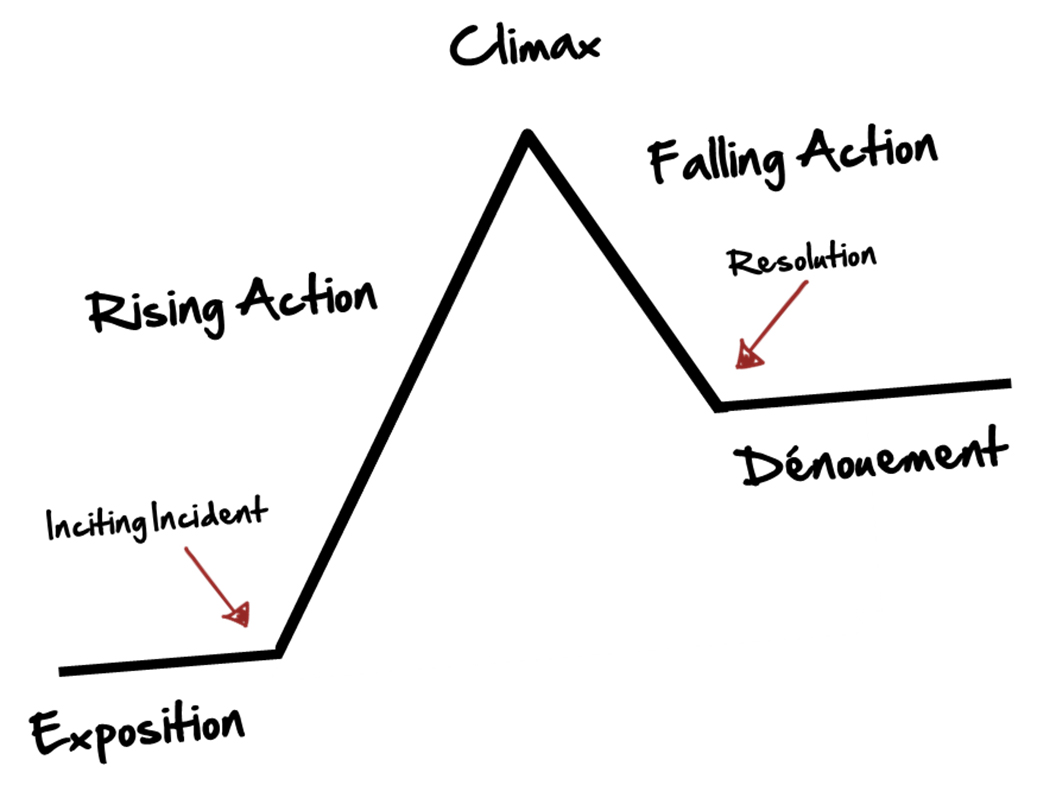
You know how on the plot diagram for a story it begins with a flat line that is called exposition...like this:

___________
Exposition

Then there is a tiny dot that is often labeled "inciting incident" and the line jumps up, like the person drawing it just got poked with needle. Like this:
(In this image, there is an arrow, not a dot. But it works the same way.)

After college and choosing a career, things in life really settle down. Or they did for me. Life begins to plod along like a reliable, lovable old pony. It isn't a bad thing. It's calming - the predictability, the comfortable familiarity. Settling down is delightful.

But then after all of my settling down and nesting and predicting -- I un-settled-down. The hubs and babe and I are about to make a big move - a physical move out of our state to a new state; a move into a tiny apartment; a move away from friends and towards family; a this changes everything move.

I feel like our move is an inciting incident. The problem is I don't know what comes next. I can't even imagine my life two weeks from now when we will presumably, if all goes according to our half-plan, be sitting amidst a myriad of boxes and trying to convince Melon that this is normal and she can indeed nap in this strange new place.

I have no idea what happens next. I have no idea how long we still stay in New State and where or when we will move on.

I feel like Anne, after she is (somewhat) forced to stay in Avonlea instead of go to college. She comments, "When I left Queen's my future seemed to stretch out before me like a straight road. I thought I could see along it for many a milestone. Now there is a bend in it. I don't know what lies around the bend..."

This is true for me. Here in Old State, my life was in stasis, the flat line of exposition; I could see the future stretched out before me with it's pleasures and pains; I knew who we would be spending our holidays with and how we would spend our leisure time, and where I would be working for the next decade or so.

Now there is a bend in the road. Or a jolt in the plot diagram.

It's pretty terrifying.

I sympathize with characters in novels now. As a reader, when the inciting incident occurs I snuggle deeper into my chair and think, "this is gonna be goooood!" because I trust that the author has a point, a purpose, a plan, a plot, a fitting resolution.

But when the story is about you - a la Stranger Than Fiction -- suddenly your palms start sweating and you're looking down the Road of Rising Action thinking, "Man I hope this works out."

While I wander down this road towards my inciting incident, I'd love to hear some tales of similar travels. Any inciting incidents in your life?


Thursday, April 2, 2015

Book Review: Bringing Up Bebe by Pamela Druckerman

Bringing Up Bebe is written by an American mother living in France. She is intrigued by the difference in behavior between French and American children (read: American kids throw their food and French kids don't) and begins investigating French parenting. This book is about her discoveries.

The last thing many moms want to do is read a dry, preachy parenting book during nap time. The few nuggets of wisdom aren't worth the horrible guilt, self-judgement, and overanalyzing. Also, I like to think that underneath the supermom exterior there is a real human being who might just want to read something that isn't about sippy cups and sleep training.

But I heartily recommend this book to all moms - and less heartily I recommend it to those who aren't moms, because it is that interesting and well written...though it may not be as funny for you. Unless you find power struggles with beings one quarter of your size amusing.

This book is far from preachy and - best of all - it is hilarious. Well-written, self-deprecating, honest, and anecdotal, I found myself wanting to read this book. I tore through it in about two days (usually reading while I was nursing).

My favorite thing about this book though is that it opened my eyes to how cultural our ideas of parenting are. Most of what I took for granted as some universal agreement about what a good mother looks like is actually unique to us Americans. It took a lot of pressure off of me to be this so-called perfect mother. Realizing that the perfect mother looks very, very different in other cultures revealed that maybe there isn't a perfect mother. Maybe all these things that I felt like I had to do (go on playdates; go to story time; breastfeed my child; stay at home; alternately work a billion hours and look like I do it with ease; prep my child for college at the age of one; never take care of myself - always the baby first!) were actually just cultural ideals that I could reject, not a solemn, ethical parenting code.

There may be some moments in the book where French parenting is a bit idealized. But I can't really blame the author for this when babies in France magically sleep through the night around 3 months for no reason that French parents can recall other than that the moms had to return to work and "the baby knew mom needed her sleep." Meanwhile, American parents are still sleep deprived several months after the baby is born and often past baby's first year.

Maybe somehow our parenting ideals are working against us? After reading this book, as well as All Joy and No Fun, I'm starting to think that may be the case. And while I have no intention of making any sweeping claims about the right way to parent (I really don't believe there is one right way), I do intend to go easy on myself and let myself parent the best I can, sans cultural commentary.


Sunday, March 29, 2015

Too much reading?

Here is a question:

Can you read too much? Is there such a thing?

Isn't that sort of like doing "too much charity work" or being "too nice" or "too pretty"?

Reading is not only fun, it's educational and whatnot. Who ever says "You learn too much! Stop learning things."

No one, that's who.

But then, people say, "Everything in moderation."

Does that mean I have to be moderate in my reading? Is it selfish of me to read? If the world was ending and I just sat on my couch and read would I be crossing a line?

I really want to know. Please tell me what you think.


Thursday, March 26, 2015

The Alot -- A Beast of Mythic Fame

No Blogspot, this is not a typo. I know a lot is not one word... I distinctly remember banging my head against the table while grading 7th, 9th, and 10th grade papers. "Why is it so difficult?" I would groan, circling yet another miserable alot in yet another miserable essay.

Enter Hyperbole and a Half. This blog traipsed into my life with a solution that was so entertaining,  true, and obvious that I wondered where it had been all my life.

The beautiful and brilliant and talented and GENIUS blogger (no, I don't know this person. No, she did not pay me to write this. Yes, she is that awesome) over at Hyperbole and a Half introduced me to the ALOT. Here is a picture she drew of the Alot:
This image was drawn by Allie Brosh. Click here to visit her blog.
I taught my kids about the Alot monster and they stopped using alot and started using a lot overnight. Every once in a while one or two kids would revert back, but I like to think it was on purpose now and not because they didn't know any better.

I hope I've intrigued you. If so, click here to read about this wondrous creature and put some socks on because you're about to laugh them off. And I don't want to know what would happen if you started laughing your socks off and DIDN'T HAVE ANY SOCKS ON!

Also a word to the lazy reader, who just can't seem to drag that little mouse arrow over to the link and click on it...because then you'd have to wait for a page to load and you don't have the time, and who knows what it might do to your internet tabs (I know; I've been there - will it open a new tab or navigate away from this page? What if it isn't funny? Why didn't this person just paste the whole story here so I don't have to click on links all the time?). But I must insist. You must go learn about the ways of the Alot. You will thank me in the comments if you do.

Also please share with all your teacher friends. It will save their forehead from a perpetual bruise.

Sunday, March 22, 2015

Harper Lee's New Novel...Please contain your excitement.

I read To Kill a Mockingbird for the first time a few years ago when I had to teach it to my sophomore class. I was (and still am) in awe of Atticus - not because he was the perfect parent, but because he was so human and natural with his children. I remember thinking that if I ever became a parent, I wanted to be like Atticus. Except I wanted my children to call me mom, not by my first name.

A few months ago I heard the delightful news that Harper Lee had been harboring a sequel, a book that was actually written before To Kill a Mockingbird, but which takes place after the events in To Kill a Mockingbird.

The good news is we don't have to wait too long either (I mean other than the 55 years we had to wait already...) -- the book is scheduled to be published in July.

For more info, listen to or read this snippet from All Things Considered.

So just how excited are you about this? Let me know in the comments.

Thursday, March 5, 2015

Ode to Imagination

The other day I took my friend's kids to the park. They are ages 4 and 2 and Baby Melon is almost 10 months now. I feared for myself. But, like all good warriors, I strapped on my armor (or in this case my baby carrier), made good use of my pockets, and dove into the fray.

It was great actually. The oldest is right at that age of make believe where you don't need anything to play other than a wide open space for lots of running and falling over dead. During one of his make believe escapades, he raced out of the jungle gym yelling, "Quick, we've got to get away from the bad guys!" Another little boy who was probably around the same age looked at his mom with sudden anxiety: "Bad guys?" he whimpered. "No, no," I looked at the mother apologetically, "these are just pretend." The little boy looked relieved. Meanwhile my friend's son had fallen over "dead" in the dirt.

I was delighted to see that someone in the world still only needs their imagination and their pointer finger (for a gun, of course) in order to enjoy themselves. I so rarely see that anymore, which is probably because I don't spend a lot of time with children that age, but also because of the evil television. I say that jokingly. I love TV and movies, especially good TV and movies. I'm really not super anti-TV. I'm just anti-only-TV.

I've been rereading the Anne of Green Gables series and Anne has imagination to spare. She has so much imagination that it makes me feel like a dull lump of reality-focused clay. Not only do I want "kids these days" to be more like Anne, I want to be more like Anne.

Why does Anne have so much imagination and I seem to have so little? What can I do to be more imaginative? After considering this for some time, I decided that Anne's main inspirations for imagination include people, books or poems, and nature.

Not even the Anne girl can just imagine things out of thin air. She needs a spark, some ideas rolling around in her head to begin with. My little friend on the playground needed to read stories about bad guys in order to make up his own. As Tozer pointed out, "We learn by using what we already know as a bridge, over which we pass to the unknown. It is not possible for the mind to crash suddenly past the familiar into the unfamiliar." I would add that we imagine by using what we already know as a bridge from the real to the unreal. For Anne, the starting point for her imagination is always a combination of people, stories, and nature.

These are often things that we don't let into our lives. I live in an apartment complex, where my view of the sky is blocked by a large hotel and a call center. When I drive I listen to music or the radio, when I'm bored I look at my phone (there's an app for boredom). I do read a substantial amount, to be fair, but I know lots people don't have the time. But Anne had the time. Anne looked at the sky, not her phone; Anne looked at people and if she didn't talk to them, she imagined things about them; if she did talk to them, then she imagined things about them later based on what they had said. I'm going to try to be more like Anne in the hopes of resurrecting my imagination.

So this is my exhortation: Feed your imagination, lest it die. Give it whatever it needs: people, books, and nature, or stranger fare than these. It is imperative that we do this -- otherwise we will be left scared on the jungle gym while others fly by us in a rush of enthusiasm for things unseen.

What sparks your imagination?

Tuesday, February 24, 2015

An Update in Reading

This month has been so busy that routine, along with all of the wonderful things that routine maintains including laundry and blog posting, has disappeared from my life completely.
Not surprisingly, I've still managed to read a few books. Because that's the second to the last thing to go (the last thing would obviously be breathing).
So here is a quick survey of my reading last month:

The Sandman: Preludes and Nocturnes, 4 stars. This is the first comic book/graphic novel that I've ever read! Reading comic books is difficult for me. My mind keeps trying to create the setting, the mood, to draw the characters and it gropes for information about these details - "Why is there so much dialogue! Why won't they stop and tell me where they are and what the air smells like and what the weather is doing?" Then I remember that it's all in a picture behind the words. So weird. But eventually I got into a good rhythm and didn't have to remind myself to slow down and look at the pictures. When I finished this collection, I had a few thoughts: That was a weird place to stop the story. Holy cannoli that was gruesome and creepy. There might have been a few sections that were pure genius. I wasn't instantly enthusiastic about it. I had to let it stew in my brain. I had to strain out the gruesome (I'm not prudish usually about violence, but for some reason, probably since there were pictures, it creeped me out) and absorb the great. Because there were two issues (I think they are called issues?) that Blew. My. Mind. One of them was an issue that switches to the point of view of a very minor character, a waitress at a diner who is a writer. She sees her customers as fuel for her writing. That's all I will say, but if you only read one issue, that would be the one to read. Neil Gaiman is extraordinary. If I was still teaching, I would seriously consider adding a lesson where we analyzed one or two issues of this text.

Anne of Green Gables, 5 billion stars. (The exaggeration is in in honor of Anne, of course.) I never realized that L.M. Montgomery was one of my favorite authors until a week ago. I got a sudden urge to reread Anne of Green Gables and now all I want to do is read Anne of Green Gables or watch Anne of Green Gables. Also, I plan on moving to Prince Edward Island. Seriously. My husband said he would do it.

Carry On Warrior, 3 stars. I can't enjoy nonfiction as much as fiction and so I always find it difficult to rate and recommend and talk about at all. Also, I have a weird voice in my head that is super judgmental when I read nonfiction. I haven't the slightest idea why. Anyway, this book was pretty hilarious, especially the anecdotes about the author and her children. I know it's cliche of me to enjoy reading about how a child threw a temper tantrum at Target just because I too may one day get to experience that joy, but what can I say, it's funnier on this side of things. The author of this text, Glennon Doyle Melton, is well known for her brutal honesty. I found this very refreshing and challenging. Sure, she had some ideas that were strange and that I disagreed with (which the voice in my head demands that I tell you), but I'd totally be friends with her. I read a review on Goodreads that said the prose was terrible. It wasn't. It was really funny. It was blog-prose or thinking-out-loud prose. But it worked for the book stylistically.

What are you reading currently?

Tuesday, February 3, 2015

"I don't care how well it's written, I only care if it's a good story."

These words were uttered by a man I spent an entire day with, but will likely never see again. Mr. Greenberg was a teacher at summer school and I was taking classes to get my teaching credential. He graciously allowed me to sit and observe in his classroom. I took away two things that day that have stuck with me: an interest in Doctor Who, and the quote mentioned above.

We were talking books during one of the breaks the kids get. Of course we were talking books. I was an English major on my way to becoming an English teacher. He was a writer and an English teacher. It was only natural that this discussion occupied our time. I don't know what prompted this comment from Mr. Greenberg. I think I was flexing my English-major muscles and made a negative comment about a new release that was getting lots of love from everyone.

So I was a little chastised when he said, "I don't care how well a book is written; I only care if it's a good story."

To this day I can't decide if I agree with him. I've read some books with an interesting story and awful prose, and some books with beautiful prose and a yawn-inducing plot. I prefer the books that have both an interesting story and beautiful prose. But I see what he was saying. Some books seem to be written for English majors - who else would willingly sit through Thomas Pynchon's The Crying of Lot 49? If you haven't read that gem, I can't even summarize the story for you because nothing really happens. I'm not kidding. There is a girl who is crazy and believes she has uncovered a conspiracy. She runs around discovering or imagining or projecting proof of this conspiracy. At the end of the book, you don't know if the conspiracy is real or if she is imagining it because she is crazy. But the prose is excellent. Very artistic and whatnot.

When I'm honest with myself, I don't want to read books like The Crying of Lot 49. I want to read books like The Lord of the Rings, or The Blue Castle, or Harry Potter, or anything by Mark Twain. Because those are really great stories.

Incidentally, they are also well written.

Which brings me to the other half of the equation: Books that are written poorly, but are great stories.

I'm reading The Girl with the Dragon Tattoo right now. (No spoilers, please, because I did just start it.) This novel has been raved about by tons of people, even fellow English teachers. Sadly, the prose is meh. True, this is quite possibly due to the translation, not the author himself. But it detracts from my experience. However riveted I am by the characters and the plot, the prose is awkwardly blunt, choppy, and has excessive chunks of exposition. So far, I am intrigued and I think I can safely say that I will really like it. But somehow the story doesn't feel complete without good, solid prose, perhaps a well-selected metaphor or a bit of elegant description.

So, Mr. Greenberg, I think I disagree with you. Story is arguably more important than how the story is told. But I'd say story is more like 60%, prose 40%, not story 100%, prose nil.

What do you think?

Sunday, January 25, 2015

Time Magazine's Top 100 Young Adult Books


Greetings!
As is often the way of the world, whenever I turn my attention to particular topic, I suddenly see it everywhere, in the most random places, when least expected. It is delightful, and also not very surprising, since, well, I'm paying attention to it. To paraphrase Sherlock, I often see, but fail to observe. Once I start observing, I find lots of things around me that are suddenly full of meaning and importance.

Since I have recently been writing about books I read when I was younger, I was pleased that Time magazine did a story just for me about the Top 100 young adult and children's books of all time (in the first issue of 2015). In fact, Time even had a blurb from author Jesmyn Ward who said that Robin McKinley's The Hero and the Crown (prequel to The Blue Sword) was her favorite book as a child! To quote Ward, "The heroine [in The Hero and the Crown] is tough, stubborn, and smart, taking on a world bent on making her less than she is. I empathized." What excellent taste she has!

Enjoy browsing these lists. I was surprised at the number of books I hadn't read, pleased with the ones they chose that I had read, and disagreed about surprisingly few of them. I was also reminded of a few books I had forgotten I'd read (Johnny Tremain anyone? Loved that book!).

Here are the links:

Top 100 Young Adult Books of All Time

Top 100 Children's Books of All Time

I'd love to hear your thoughts when you are done looking at the lists. Any surprises? Remind you of any of your favorite books? Any that you think really shouldn't be on this list?

Saturday, January 17, 2015

Pride and Prejudice: My first time

When I was a child, my method for choosing what to read was to go to the library and read every book by an author that I already knew I liked.

Obviously, this was a flawed method because I ran out of books pretty quickly.

If I wasn't already familiar with an author, I approached a new book like I might a strange dog. I would look at it carefully. I would read the back of the book, the inside flap, maybe scan a few pages, ready to drop it and run at the slightest sign of something I didn't like. I had to get a feel for the book, and it had to feel right. Otherwise I wouldn't read it. I turned away from the tawdry romances with their ubiquitous shirtless Fabios, and the garish covers of mystery novels, usually sporting some kind of intriguing trinket on a purple cover with yellow text, and many of the juvenile contemporary young adult novels that showed a photograph of a depressed teenager. I knew these were not the books for me; they didn't feel right. I wasn't interested in them - I felt I already knew all their secrets. Or that their secrets weren't worth knowing.

But if I was ever going to find new authors, risks had to be taken. I still remember the first Jane Austen novel I read. Inadvertently, I began with her most popular work, Pride and Prejudice. The copy I stumbled across was a red book, with gold lettering, the kind that comes in those fancy library collections where all the books match. I know it came from a collection such as this because the book was at my grandparents house, buried amidst other classics like Don Quixote and War and Peace.

I was probably only twelve at the time, though that sounds young, I couldn't have been much older because my mom was pregnant with my younger sister and my older sister and I had been sent to stay at my grandparents house for two weeks because we'd been exposed to the chicken pox and had to be sent away since my mother had never had them.

I can't stress how bored I was. So. Bored. It wasn't my grandparents' fault. They were enjoying their retirement and hadn't had kids around in years. They had a strict routine that involved working out before the sun was up, eating small portions of vegetables and cottage cheese, and falling asleep on the couch at 7 pm watching PBS.

I could have read any of the books on that shelf and I don't remember why I chose to look at Pride and Prejudice. Deprived of any picture on the front, any writing on the back cover, and no book jacket with helpful hints, I didn't have much to go on. I opened it and read a few lines. And didn't put it down. I remember a few chapters later thinking, How did I not know about this book or this author? By that time my father had already read us a few Dickens' novels, Tolkien, C.S. Lewis, and Wilke Collins, so it was a genuine question.

The wonderful thing about reading Pride and Prejudice so young was that I was truly taken in by the novel. When Darcy proposed to Elizabeth I was shocked. I hated him; I'd even pictured him like one of my classic ugly bad guys. Kind of like Gaston. Then when Elizabeth started falling for him I was gradually won over. I'm pretty sure I stopped reading and mentally changed his appearance to be more fitting of his new role as lead man.

That first read, I really experienced Darcy the way Elizabeth did. I'm not sure many people get to experience Pride and Prejudice like that, because most people know all about it before they read it and because most people bring some amount of maturity to the book and aren't fooled when Elizabeth despises him. If I read the book now, I know I would have identified Darcy right off the bat as the guy. After all, he was the richest and Austen, I learned later as I devoured all 6 and a half of her books, is all about the happy endings.

What about you? Did you know Darcy was the guy right from the beginning? Were you fooled along with Elizabeth? When did you first read the book?

Wednesday, January 14, 2015

The Blue Sword

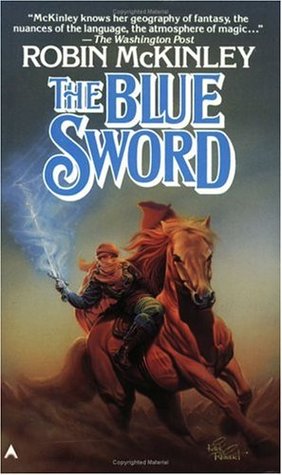
I discovered Robin McKinley when my dad read us her book The Outlaws of Sherwood, a pragmatic and slightly depressing retelling of the Robin Hood legend. I remember attempting to read a few of her other books and not falling in love with them really, until I read The Blue Sword

The Blue Sword is about a girl named Harry. That’s right - a girl. You love it already don’t you? I couldn’t tell you why her name is Harry, even though I’ve read the book several times. I think it is a nick name. Harry is forced to move to a new town when her father dies, a town that is essentially a military outpost and is on the edge of a vast desert, home to a strange and foreign people. Harry is inadvertently swept up in a war between these foreigners and their long-time enemies. 

Spoiler alert: She gets a blue sword.

If you’ve been reading my blog posts about the books I loved as a child, you will no doubt notice a theme when I say that I loved Harry because she wasn’t proper and well-behaved. She preferred horseback riding to sitting daintily in a parlor and not to give anything away, she kicks some pretty serious keister by the end of the book.

This book fits squarely in the fantasy genre and is technically young adult, but McKinley is a talented author, so it is young adult I think mainly because it doesn’t have cursing, sex, and violence or other mature content.


If you don’t love fantasy, you might not enjoy this book. It’s fairly traditional in it’s fantastical elements and plot. If you do love fantasy, you will enjoy McKinley’s world building and the development of Harry’s character.

Wednesday, January 7, 2015

BabyLit books

BabyLit books are adorable, delightful books that make literature accessible for very small children. Or maybe they just make it more fun for literature-loving adults when they read these books to their little ones. Either way, I highly recommend this series.


I didn't read these books when I was a baby, so this post is a bit off-topic. However, my small one has many of these (thanks to many of my wonderful friends and family!) and I love reading them to her.  So some day, these books will be on a list of books she read as a child.

The books don't necessarily tell the stories they are named after; instead, they are a collection of "primers" (sound primer, opposites primer, ocean primer, etc...) so little ones can learn while they read. But there is often subtle humor included in the text or drawings for adults who have read the stories, or sometimes beautiful quotes.

I promise these will be a huge hit at the next baby shower you attend. Or the next time you snuggle up to read a bedtime story to your toddler. You can buy them on Amazon or on the BabyLit website.

Wednesday, December 31, 2014

The Ordinary Princess

Despite my last post, I didn’t realize how personal it could be to write about favorite childhood books until I sat down to write this post. It’s hard to explain why you loved a book as a child without dredging up childhood insecurities and idiosyncrasies.

So here you are: a book recommendation and a healthy dose of self-deprecation.

One of my favorite books growing up was The Ordinary Princess by M.M.Kaye. I got it from the library and had one of those magical experiences where the book was everything I wanted it to be and more.

Two things you should know about this book:
1. It has beautiful illustrations (see above).
2. The prose is charming.

Why did I love this book as a child? I loved this book because it is all about an ordinary princess.  I had quite the ugly duckling complex as a child. I really didn't think much of my physical appearance. I felt like my older sister was the “pretty one” and I was the “smart one.” Who knows if I made this up in my head or picked this up from the small comments adults make in passing that children end up keeping in the deepest places of their hearts? But however it was that I ended up with this complex, I was enamored with Princess Amy because all of her sisters were beautiful and she was not. 

She tore her dresses and got freckles from sitting out in the sun. 

She had mousy hair. 

She was clumsy.

And she was special. Even though she wasn’t pretty and didn’t behave like a proper princess, she had a grand adventure and eventually found love, someone who thought she was beautiful just the way she was, inside and out.


I suspect that I am not the only little girl in the world to feel unattractive and unfeminine. I think my complex was and is far more universal than my solipsistic little self realized at the time. With that in mind, I highly recommend this classic tale of the conflict between inner and outer beauty, social and personal expectations, and the need for acceptance. It is an excellent book for ordinary princesses of all ages.

Monday, December 29, 2014

Books We Read as Children, Part One

When you read a book as a child, it becomes a part of your identity in a way that no other reading in your whole life does.” Kathleen Kelly, You’ve Got Mail

If you want animated conversation with a reader, ask them what books they read as a child. Invariably, their face will light up as they chronicle the books they read when they were young - sometimes completely random books that you’ve never heard of, other times classic stories that you remember reading as well.

Mind, this only works for people who have been readers from a young age. Ask the average freshman what they read when they were kids and they will stare at you blankly and mutter something about Dr. Seuss (a very good writer, I must add).

There are three strange things about favorite childhood books:

1: The books that one person claims are phenomenal, one of their favorites from childhood, a classic, are oftentimes books not many other people recognize.
2: These books will be vehemently defended by these people as wonderful books, even when other people, who are adults, read them and fail to see many (or any) redeeming qualities.
3: Therefore, it can be inferred there is some kind of magical bond that occurs when one is young and falling in love with a book, and that due to this bond, quality does not matter. 

I’m sure you have your own books that you love and reread now as an adult with fond sentimentality. For me, these books are The Blue Castle, The Blue Sword (no, these aren’t part of a series and are in two completely different genres), and The Ordinary Princess, among others.

Note my obvious penchant for novels with blue in the title.

Anyway, I recently read The Blue Castle to my husband. He agreed that it was funny, but told me, “it’s pretty much a romance.”
“No, it’s not,” I defended angrily. “It’s so funny, and it’s really about how the character changes and gets her dream life and doesn’t let her family control her any more…” my voice trailed away while my husband waited patiently.  A pause. “Okay, it’s a romance.”

The truth is, The Blue Castle, written by L.M. Montgomery, beloved author of Anne of Green Gables, is more or less a young adult romance. But to me it was so much more. When I read it as a child, the main character reminded me of the way I could be sometimes: timid, easily cowed, submissive to a fault, and dissatisfied with her life (most teens are dissatisfied with their life at one time or another). Then the character changes. She becomes bold and goes after the life she wants. That was inspiring to me as a child, and still is, really. That book became a reminder of all that I was capable of doing.

So when I read it again, and again, and again as an adult, I didn’t necessarily see the framework of any particular genre; I saw the girl I was when I first read it, remembered how I responded to it the first time I finished it (the ending is just delightful). I saw past me and present me and future me in that slim little book. I saw the flaws I struggled with then, the weaknesses I still struggle with, and all that I’ve overcome.

Years ago, a friend asked me a question dreaded by all book lovers:

“What is your favorite book?”

Groan. He noticed my dismay and quickly added, “What book do you find yourself rereading over and over?”

I’m a fairly private person and so I’m still surprised that I didn’t answer vaguely or give some scholarly answer like “Jane Austen books.” I think part of me didn't want to make myself appear more scholarly than I actually am. I was an English major and love classic authors like Dickens and Twain, so it would have been easy to put on a facade of sophistication - twirling my non-existent mustache and saying, “well it’s a toss up between Shakespeare’s Hamlet and Dickens’ Great Expectations, my good man.”

But it wasn’t true. In a moment of unexpected honesty, I replied, “The Blue Castle by L.M. Montgomery.”

My friend raised an eyebrow. “Really? That surprises me,” he said, rather unnecessarily. Then he got pulled away by someone and I was left feeling a bit deflated.

The truth is, everyone is a bit surprised by the books that have the most profound impact on other people because, to quote Edmund Wilson, “no two persons ever read the same book.” No matter how close you are to a friend or family member, you might not always fully understand why they have a bond with their favorite books. 

Why those books spoke into their life in a quiet way.

Why they saw in that book a mirror, or a vision, or a dream.

So as much as I love to discuss books and recommend books and read books that my friends are reading, I know deep down that there is a part of my reading experience that is only mine. 

Which is quite possibly the reason I keep reading.

***********

Over the next few days and weeks I'm going to venture back into the dusty cobwebs of the books I loved as a child and share them with you on this blog. I'd love to hear in the comments what some of your favorites were as a child.


Friday, December 26, 2014

A bookmark without a home

Today I finished Assassin's Apprentice, the first book of a fantasy series written by Robin Hobb. It was a fantastic finale, a nail-biter to the end, and I teared up in just the last few sentences.

Once I closed the book, I noticed my bookmark, sitting there on the couch...and I had no idea what to do with it. Where do you store a bookmark if not in a book? I am one of those people who has to have a place for everything, so this was a serious problem. I didn't want it on my nightstand, it didn't feel right in my drawer with my notebook and Bible, it couldn't just sit out on top of a random book.

It was quite the conundrum. I finally just decided I'd have to start another book immediately so I'd have a place to keep it.

But now I want to know: Where do you store your bookmarks?

That way I can have a backup plan in case my bookmark becomes homeless again.