The Storybook Cafe on Elm was all concrete, metal, and glass. There was a row of stools facing the window, lined with hipsters and their Macboooks, no doubt earning money through social media management and marketing.
The barista wore a red flannel shirt, a beard, and brown boots. How, I wondered, did this lumberjack end up in perpetually sunny, 70-degree Beachtown, California. I glanced at the menu.
"What can I get for you?"
I put the menu down. "I will have one conflict-free life. To go."
"That's not on the menu."
I frowned and glanced at the menu again. Then I winked at him casually.
"It is for me."
"It's not on the menu for anyone."
"That's not true. I know for a fact you just served it to Miss Knee-high Boots and Tunic over there." I gestured to a tall blonde, sipping from her cup dreamily, staring at her screen.
"What other customers ordered doesn't matter. And besides, that wasn't what she ordered. Because it's not on the menu."
"It should be. It would really help your sales."
"That's not exactly the point."
"You mean it's not your job to give the customer what they want?"
"We serve stories, Ma'm. Thus the name."
Hipsters. What bunch of smart-asses. I persisted: "But that's all I want. I don't want any of these other things: 8 ounces of sorrow with a joy rinse? Relationship conflict with a character boost? Who would want that? Sounds like you get a lot of what you don't want, for just a tiny bit of what you do want."
"I don't make the menu. I just serve it. If you need more time to decide, I will help the next guest while you consider." He gestured to the man behind me and I stepped aside, disgruntled.
I took a seat at a glass table.
All I wanted was to be happy and stress-free. I didn't see the problem. An old man sitting next to me wearing a scarf and dark-rimmed glasses interrupted my thoughts.
"Might I make a suggestion?"
I was suspicious, but eternally polite, as always - a trick I learned to reduce conflict on my own. "Certainly."
"If you want a conflict-free life, you can try next-door at Dissipation Brewery. But I must warn you, I spent a lot of time there in my younger days and the conflict-free life doesn't exist. It might last for awhile, but it always disappears. That's why I dreamed up this." He gestured to the cafe.
"How do you stay in business?" I asked bluntly.
"Because people only think they want a conflict-free life. What they really want is a meaningful life; they want strong character, quiet confidence, and trust in something beyond themselves. Even when they say they don't want those things, they do."
I sat there annoyed. I wished I could tell him to stop talking to me.
"The good stories always have conflict because without conflict, people would stay in stasis - forever at the beginning of their story, never changing, never growing, never reaching the promised land. Just stuck at the beginning of the story. What if Frodo had stayed in the Shire? What if Huck Finn had stayed with his father?"
"They would have avoided a lot of trouble?" I quipped.
He ignored me.
"What do you really want out of your story? I bet if you thought about it, you would discover that the conflict-free life is priced much higher than any human being can afford. That is why it is not on the menu. It costs your character, your empathy, your hopefulness, your dreams, the fulfilling of your needs, your spiritual life, your personal relationships, and cost upon cost until your life is bankrupt of worth." He stood and folded his paper, taking his cane as he did so.
"For dissipation, you can visit the place next door. To get your life started, stop protecting yourself. He who seeks to save his life will surely lose it."
I sat silently. I knew I should feel inspired. But I just felt nothing.
It may have been a few hours, or minutes, but when I looked up, the lumberjack stood in front of me with a frothy latte.
"The gentlemen you were speaking with earlier ordered this for you."
"What is it?" I looked at it suspiciously.
"He said not to tell you. But to say that it was good." Then he set it down and walked away.
Wednesday, March 2, 2016
Monday, April 6, 2015
The Inciting Incident
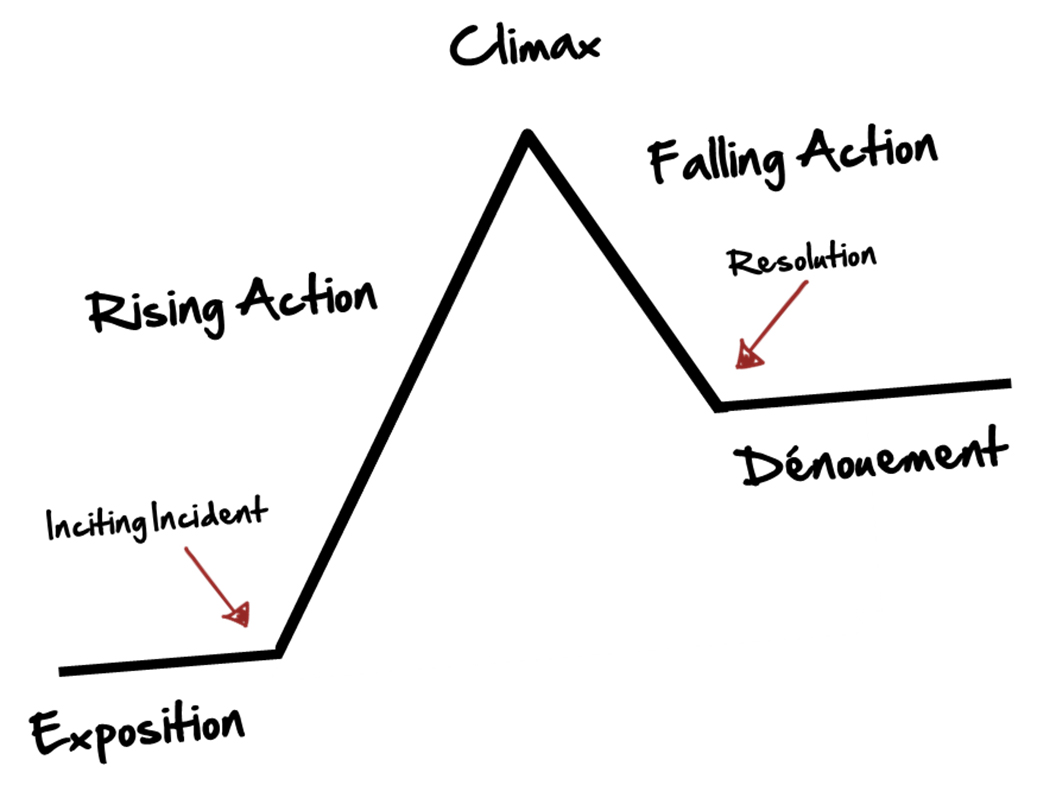
You know how on the plot diagram for a story it begins with a flat line that is called exposition...like this:
___________
Exposition
Then there is a tiny dot that is often labeled "inciting incident" and the line jumps up, like the person drawing it just got poked with needle. Like this:
(In this image, there is an arrow, not a dot. But it works the same way.)
After college and choosing a career, things in life really settle down. Or they did for me. Life begins to plod along like a reliable, lovable old pony. It isn't a bad thing. It's calming - the predictability, the comfortable familiarity. Settling down is delightful.
But then after all of my settling down and nesting and predicting -- I un-settled-down. The hubs and babe and I are about to make a big move - a physical move out of our state to a new state; a move into a tiny apartment; a move away from friends and towards family; a this changes everything move.
I feel like our move is an inciting incident. The problem is I don't know what comes next. I can't even imagine my life two weeks from now when we will presumably, if all goes according to our half-plan, be sitting amidst a myriad of boxes and trying to convince Melon that this is normal and she can indeed nap in this strange new place.
I have no idea what happens next. I have no idea how long we still stay in New State and where or when we will move on.
I feel like Anne, after she is (somewhat) forced to stay in Avonlea instead of go to college. She comments, "When I left Queen's my future seemed to stretch out before me like a straight road. I thought I could see along it for many a milestone. Now there is a bend in it. I don't know what lies around the bend..."
This is true for me. Here in Old State, my life was in stasis, the flat line of exposition; I could see the future stretched out before me with it's pleasures and pains; I knew who we would be spending our holidays with and how we would spend our leisure time, and where I would be working for the next decade or so.
Now there is a bend in the road. Or a jolt in the plot diagram.
It's pretty terrifying.
I sympathize with characters in novels now. As a reader, when the inciting incident occurs I snuggle deeper into my chair and think, "this is gonna be goooood!" because I trust that the author has a point, a purpose, a plan, a plot, a fitting resolution.
But when the story is about you - a la Stranger Than Fiction -- suddenly your palms start sweating and you're looking down the Road of Rising Action thinking, "Man I hope this works out."
While I wander down this road towards my inciting incident, I'd love to hear some tales of similar travels. Any inciting incidents in your life?
___________
Exposition
Then there is a tiny dot that is often labeled "inciting incident" and the line jumps up, like the person drawing it just got poked with needle. Like this:
(In this image, there is an arrow, not a dot. But it works the same way.)
After college and choosing a career, things in life really settle down. Or they did for me. Life begins to plod along like a reliable, lovable old pony. It isn't a bad thing. It's calming - the predictability, the comfortable familiarity. Settling down is delightful.
But then after all of my settling down and nesting and predicting -- I un-settled-down. The hubs and babe and I are about to make a big move - a physical move out of our state to a new state; a move into a tiny apartment; a move away from friends and towards family; a this changes everything move.
I feel like our move is an inciting incident. The problem is I don't know what comes next. I can't even imagine my life two weeks from now when we will presumably, if all goes according to our half-plan, be sitting amidst a myriad of boxes and trying to convince Melon that this is normal and she can indeed nap in this strange new place.
I have no idea what happens next. I have no idea how long we still stay in New State and where or when we will move on.
I feel like Anne, after she is (somewhat) forced to stay in Avonlea instead of go to college. She comments, "When I left Queen's my future seemed to stretch out before me like a straight road. I thought I could see along it for many a milestone. Now there is a bend in it. I don't know what lies around the bend..."
This is true for me. Here in Old State, my life was in stasis, the flat line of exposition; I could see the future stretched out before me with it's pleasures and pains; I knew who we would be spending our holidays with and how we would spend our leisure time, and where I would be working for the next decade or so.
Now there is a bend in the road. Or a jolt in the plot diagram.
It's pretty terrifying.
I sympathize with characters in novels now. As a reader, when the inciting incident occurs I snuggle deeper into my chair and think, "this is gonna be goooood!" because I trust that the author has a point, a purpose, a plan, a plot, a fitting resolution.
But when the story is about you - a la Stranger Than Fiction -- suddenly your palms start sweating and you're looking down the Road of Rising Action thinking, "Man I hope this works out."
While I wander down this road towards my inciting incident, I'd love to hear some tales of similar travels. Any inciting incidents in your life?
Thursday, April 2, 2015
Book Review: Bringing Up Bebe by Pamela Druckerman
The last thing many moms want to do is read a dry, preachy parenting book during nap time. The few nuggets of wisdom aren't worth the horrible guilt, self-judgement, and overanalyzing. Also, I like to think that underneath the supermom exterior there is a real human being who might just want to read something that isn't about sippy cups and sleep training.
But I heartily recommend this book to all moms - and less heartily I recommend it to those who aren't moms, because it is that interesting and well written...though it may not be as funny for you. Unless you find power struggles with beings one quarter of your size amusing.
This book is far from preachy and - best of all - it is hilarious. Well-written, self-deprecating, honest, and anecdotal, I found myself wanting to read this book. I tore through it in about two days (usually reading while I was nursing).
My favorite thing about this book though is that it opened my eyes to how cultural our ideas of parenting are. Most of what I took for granted as some universal agreement about what a good mother looks like is actually unique to us Americans. It took a lot of pressure off of me to be this so-called perfect mother. Realizing that the perfect mother looks very, very different in other cultures revealed that maybe there isn't a perfect mother. Maybe all these things that I felt like I had to do (go on playdates; go to story time; breastfeed my child; stay at home; alternately work a billion hours and look like I do it with ease; prep my child for college at the age of one; never take care of myself - always the baby first!) were actually just cultural ideals that I could reject, not a solemn, ethical parenting code.
There may be some moments in the book where French parenting is a bit idealized. But I can't really blame the author for this when babies in France magically sleep through the night around 3 months for no reason that French parents can recall other than that the moms had to return to work and "the baby knew mom needed her sleep." Meanwhile, American parents are still sleep deprived several months after the baby is born and often past baby's first year.
Maybe somehow our parenting ideals are working against us? After reading this book, as well as All Joy and No Fun, I'm starting to think that may be the case. And while I have no intention of making any sweeping claims about the right way to parent (I really don't believe there is one right way), I do intend to go easy on myself and let myself parent the best I can, sans cultural commentary.
Sunday, March 29, 2015
Too much reading?
Here is a question:
Can you read too much? Is there such a thing?
Isn't that sort of like doing "too much charity work" or being "too nice" or "too pretty"?
Reading is not only fun, it's educational and whatnot. Who ever says "You learn too much! Stop learning things."
No one, that's who.
But then, people say, "Everything in moderation."
Does that mean I have to be moderate in my reading? Is it selfish of me to read? If the world was ending and I just sat on my couch and read would I be crossing a line?
I really want to know. Please tell me what you think.
Can you read too much? Is there such a thing?
Isn't that sort of like doing "too much charity work" or being "too nice" or "too pretty"?
Reading is not only fun, it's educational and whatnot. Who ever says "You learn too much! Stop learning things."
No one, that's who.
But then, people say, "Everything in moderation."
Does that mean I have to be moderate in my reading? Is it selfish of me to read? If the world was ending and I just sat on my couch and read would I be crossing a line?
I really want to know. Please tell me what you think.
Thursday, March 26, 2015
The Alot -- A Beast of Mythic Fame
No Blogspot, this is not a typo. I know a lot is not one word... I distinctly remember banging my head against the table while grading 7th, 9th, and 10th grade papers. "Why is it so difficult?" I would groan, circling yet another miserable alot in yet another miserable essay.
Enter Hyperbole and a Half. This blog traipsed into my life with a solution that was so entertaining, true, and obvious that I wondered where it had been all my life.
The beautiful and brilliant and talented and GENIUS blogger (no, I don't know this person. No, she did not pay me to write this. Yes, she is that awesome) over at Hyperbole and a Half introduced me to the ALOT. Here is a picture she drew of the Alot:
I taught my kids about the Alot monster and they stopped using alot and started using a lot overnight. Every once in a while one or two kids would revert back, but I like to think it was on purpose now and not because they didn't know any better.
Enter Hyperbole and a Half. This blog traipsed into my life with a solution that was so entertaining, true, and obvious that I wondered where it had been all my life.
The beautiful and brilliant and talented and GENIUS blogger (no, I don't know this person. No, she did not pay me to write this. Yes, she is that awesome) over at Hyperbole and a Half introduced me to the ALOT. Here is a picture she drew of the Alot:
![]() |
| This image was drawn by Allie Brosh. Click here to visit her blog. |
I hope I've intrigued you. If so, click here to read about this wondrous creature and put some socks on because you're about to laugh them off. And I don't want to know what would happen if you started laughing your socks off and DIDN'T HAVE ANY SOCKS ON!
Also a word to the lazy reader, who just can't seem to drag that little mouse arrow over to the link and click on it...because then you'd have to wait for a page to load and you don't have the time, and who knows what it might do to your internet tabs (I know; I've been there - will it open a new tab or navigate away from this page? What if it isn't funny? Why didn't this person just paste the whole story here so I don't have to click on links all the time?). But I must insist. You must go learn about the ways of the Alot. You will thank me in the comments if you do.
Also please share with all your teacher friends. It will save their forehead from a perpetual bruise.
Sunday, March 22, 2015
Harper Lee's New Novel...Please contain your excitement.
I read To Kill a Mockingbird for the first time a few years ago when I had to teach it to my sophomore class. I was (and still am) in awe of Atticus - not because he was the perfect parent, but because he was so human and natural with his children. I remember thinking that if I ever became a parent, I wanted to be like Atticus. Except I wanted my children to call me mom, not by my first name.
A few months ago I heard the delightful news that Harper Lee had been harboring a sequel, a book that was actually written before To Kill a Mockingbird, but which takes place after the events in To Kill a Mockingbird.
The good news is we don't have to wait too long either (I mean other than the 55 years we had to wait already...) -- the book is scheduled to be published in July.
For more info, listen to or read this snippet from All Things Considered.
So just how excited are you about this? Let me know in the comments.
A few months ago I heard the delightful news that Harper Lee had been harboring a sequel, a book that was actually written before To Kill a Mockingbird, but which takes place after the events in To Kill a Mockingbird.
The good news is we don't have to wait too long either (I mean other than the 55 years we had to wait already...) -- the book is scheduled to be published in July.
For more info, listen to or read this snippet from All Things Considered.
So just how excited are you about this? Let me know in the comments.
Labels:
Books,
Fiction,
Harper Lee,
NPR,
Parenting,
Reading,
Shared article
Thursday, March 5, 2015
Ode to Imagination
The other day I took my friend's kids to the park. They are ages 4 and 2 and Baby Melon is almost 10 months now. I feared for myself. But, like all good warriors, I strapped on my armor (or in this case my baby carrier), made good use of my pockets, and dove into the fray.
It was great actually. The oldest is right at that age of make believe where you don't need anything to play other than a wide open space for lots of running and falling over dead. During one of his make believe escapades, he raced out of the jungle gym yelling, "Quick, we've got to get away from the bad guys!" Another little boy who was probably around the same age looked at his mom with sudden anxiety: "Bad guys?" he whimpered. "No, no," I looked at the mother apologetically, "these are just pretend." The little boy looked relieved. Meanwhile my friend's son had fallen over "dead" in the dirt.
I was delighted to see that someone in the world still only needs their imagination and their pointer finger (for a gun, of course) in order to enjoy themselves. I so rarely see that anymore, which is probably because I don't spend a lot of time with children that age, but also because of the evil television. I say that jokingly. I love TV and movies, especially good TV and movies. I'm really not super anti-TV. I'm just anti-only-TV.
I've been rereading the Anne of Green Gables series and Anne has imagination to spare. She has so much imagination that it makes me feel like a dull lump of reality-focused clay. Not only do I want "kids these days" to be more like Anne, I want to be more like Anne.
Why does Anne have so much imagination and I seem to have so little? What can I do to be more imaginative? After considering this for some time, I decided that Anne's main inspirations for imagination include people, books or poems, and nature.
Not even the Anne girl can just imagine things out of thin air. She needs a spark, some ideas rolling around in her head to begin with. My little friend on the playground needed to read stories about bad guys in order to make up his own. As Tozer pointed out, "We learn by using what we already know as a bridge, over which we pass to the unknown. It is not possible for the mind to crash suddenly past the familiar into the unfamiliar." I would add that we imagine by using what we already know as a bridge from the real to the unreal. For Anne, the starting point for her imagination is always a combination of people, stories, and nature.
These are often things that we don't let into our lives. I live in an apartment complex, where my view of the sky is blocked by a large hotel and a call center. When I drive I listen to music or the radio, when I'm bored I look at my phone (there's an app for boredom). I do read a substantial amount, to be fair, but I know lots people don't have the time. But Anne had the time. Anne looked at the sky, not her phone; Anne looked at people and if she didn't talk to them, she imagined things about them; if she did talk to them, then she imagined things about them later based on what they had said. I'm going to try to be more like Anne in the hopes of resurrecting my imagination.
So this is my exhortation: Feed your imagination, lest it die. Give it whatever it needs: people, books, and nature, or stranger fare than these. It is imperative that we do this -- otherwise we will be left scared on the jungle gym while others fly by us in a rush of enthusiasm for things unseen.
What sparks your imagination?
It was great actually. The oldest is right at that age of make believe where you don't need anything to play other than a wide open space for lots of running and falling over dead. During one of his make believe escapades, he raced out of the jungle gym yelling, "Quick, we've got to get away from the bad guys!" Another little boy who was probably around the same age looked at his mom with sudden anxiety: "Bad guys?" he whimpered. "No, no," I looked at the mother apologetically, "these are just pretend." The little boy looked relieved. Meanwhile my friend's son had fallen over "dead" in the dirt.
I was delighted to see that someone in the world still only needs their imagination and their pointer finger (for a gun, of course) in order to enjoy themselves. I so rarely see that anymore, which is probably because I don't spend a lot of time with children that age, but also because of the evil television. I say that jokingly. I love TV and movies, especially good TV and movies. I'm really not super anti-TV. I'm just anti-only-TV.
I've been rereading the Anne of Green Gables series and Anne has imagination to spare. She has so much imagination that it makes me feel like a dull lump of reality-focused clay. Not only do I want "kids these days" to be more like Anne, I want to be more like Anne.
Why does Anne have so much imagination and I seem to have so little? What can I do to be more imaginative? After considering this for some time, I decided that Anne's main inspirations for imagination include people, books or poems, and nature.
Not even the Anne girl can just imagine things out of thin air. She needs a spark, some ideas rolling around in her head to begin with. My little friend on the playground needed to read stories about bad guys in order to make up his own. As Tozer pointed out, "We learn by using what we already know as a bridge, over which we pass to the unknown. It is not possible for the mind to crash suddenly past the familiar into the unfamiliar." I would add that we imagine by using what we already know as a bridge from the real to the unreal. For Anne, the starting point for her imagination is always a combination of people, stories, and nature.
These are often things that we don't let into our lives. I live in an apartment complex, where my view of the sky is blocked by a large hotel and a call center. When I drive I listen to music or the radio, when I'm bored I look at my phone (there's an app for boredom). I do read a substantial amount, to be fair, but I know lots people don't have the time. But Anne had the time. Anne looked at the sky, not her phone; Anne looked at people and if she didn't talk to them, she imagined things about them; if she did talk to them, then she imagined things about them later based on what they had said. I'm going to try to be more like Anne in the hopes of resurrecting my imagination.
So this is my exhortation: Feed your imagination, lest it die. Give it whatever it needs: people, books, and nature, or stranger fare than these. It is imperative that we do this -- otherwise we will be left scared on the jungle gym while others fly by us in a rush of enthusiasm for things unseen.
What sparks your imagination?
Subscribe to:
Posts (Atom)