Showing posts with label Fiction. Show all posts

Wednesday, March 2, 2016

"One Conflict-Free Life Please. To Go."

The Storybook Cafe on Elm was all concrete, metal, and glass. There was a row of stools facing the window, lined with hipsters and their Macboooks, no doubt earning money through social media management and marketing.

The barista wore a red flannel shirt, a beard, and brown boots. How, I wondered, did this lumberjack end up in perpetually sunny, 70-degree Beachtown, California. I glanced at the menu.


"What can I get for you?"

I put the menu down. "I will have one conflict-free life. To go."

"That's not on the menu."

I frowned and glanced at the menu again. Then I winked at him casually.

"It is for me."

"It's not on the menu for anyone."

"That's not true. I know for a fact you just served it to Miss Knee-high Boots and Tunic over there." I gestured to a tall blonde, sipping from her cup dreamily, staring at her screen.

"What other customers ordered doesn't matter. And besides, that wasn't what she ordered. Because it's not on the menu."

"It should be. It would really help your sales."

"That's not exactly the point."

"You mean it's not your job to give the customer what they want?"

"We serve stories, Ma'm. Thus the name."

Hipsters. What bunch of smart-asses. I persisted: "But that's all I want. I don't want any of these other things: 8 ounces of sorrow with a joy rinse? Relationship conflict with a character boost? Who would want that? Sounds like you get a lot of what you don't want, for just a tiny bit of what you do want."

"I don't make the menu. I just serve it. If you need more time to decide, I will help the next guest while you consider." He gestured to the man behind me and I stepped aside, disgruntled.

I took a seat at a glass table.

All I wanted was to be happy and stress-free. I didn't see the problem. An old man sitting next to me wearing a scarf and dark-rimmed glasses interrupted my thoughts.

"Might I make a suggestion?"

I was suspicious, but eternally polite, as always - a trick I learned to reduce conflict on my own. "Certainly."

"If you want a conflict-free life, you can try next-door at Dissipation Brewery. But I must warn you, I spent a lot of time there in my younger days and the conflict-free life doesn't exist. It might last for awhile, but it always disappears. That's why I dreamed up this." He gestured to the cafe.

"How do you stay in business?" I asked bluntly.

"Because people only think they want a conflict-free life. What they really want is a meaningful life; they want strong character, quiet confidence, and trust in something beyond themselves. Even when they say they don't want those things, they do."

I sat there annoyed. I wished I could tell him to stop talking to me.

"The good stories always have conflict because without conflict, people would stay in stasis - forever at the beginning of their story, never changing, never growing, never reaching the promised land. Just stuck at the beginning of the story. What if Frodo had stayed in the Shire? What if Huck Finn had stayed with his father?"

"They would have avoided a lot of trouble?" I quipped.

He ignored me.

"What do you really want out of your story? I bet if you thought about it, you would discover that the conflict-free life is priced much higher than any human being can afford. That is why it is not on the menu. It costs your character, your empathy, your hopefulness, your dreams, the fulfilling of your needs, your spiritual life, your personal relationships, and cost upon cost until your life is bankrupt of worth." He stood and folded his paper, taking his cane as he did so.

"For dissipation, you can visit the place next door. To get your life started, stop protecting yourself. He who seeks to save his life will surely lose it."

I sat silently. I knew I should feel inspired. But I just felt nothing.

It may have been a few hours, or minutes, but when I looked up, the lumberjack stood in front of me with a frothy latte.

"The gentlemen you were speaking with earlier ordered this for you."

"What is it?" I looked at it suspiciously.

"He said not to tell you. But to say that it was good." Then he set it down and walked away.


Sunday, March 22, 2015

Harper Lee's New Novel...Please contain your excitement.

I read To Kill a Mockingbird for the first time a few years ago when I had to teach it to my sophomore class. I was (and still am) in awe of Atticus - not because he was the perfect parent, but because he was so human and natural with his children. I remember thinking that if I ever became a parent, I wanted to be like Atticus. Except I wanted my children to call me mom, not by my first name.

A few months ago I heard the delightful news that Harper Lee had been harboring a sequel, a book that was actually written before To Kill a Mockingbird, but which takes place after the events in To Kill a Mockingbird.

The good news is we don't have to wait too long either (I mean other than the 55 years we had to wait already...) -- the book is scheduled to be published in July.

For more info, listen to or read this snippet from All Things Considered.

So just how excited are you about this? Let me know in the comments.

Tuesday, February 24, 2015

An Update in Reading

This month has been so busy that routine, along with all of the wonderful things that routine maintains including laundry and blog posting, has disappeared from my life completely.
Not surprisingly, I've still managed to read a few books. Because that's the second to the last thing to go (the last thing would obviously be breathing).
So here is a quick survey of my reading last month:

The Sandman: Preludes and Nocturnes, 4 stars. This is the first comic book/graphic novel that I've ever read! Reading comic books is difficult for me. My mind keeps trying to create the setting, the mood, to draw the characters and it gropes for information about these details - "Why is there so much dialogue! Why won't they stop and tell me where they are and what the air smells like and what the weather is doing?" Then I remember that it's all in a picture behind the words. So weird. But eventually I got into a good rhythm and didn't have to remind myself to slow down and look at the pictures. When I finished this collection, I had a few thoughts: That was a weird place to stop the story. Holy cannoli that was gruesome and creepy. There might have been a few sections that were pure genius. I wasn't instantly enthusiastic about it. I had to let it stew in my brain. I had to strain out the gruesome (I'm not prudish usually about violence, but for some reason, probably since there were pictures, it creeped me out) and absorb the great. Because there were two issues (I think they are called issues?) that Blew. My. Mind. One of them was an issue that switches to the point of view of a very minor character, a waitress at a diner who is a writer. She sees her customers as fuel for her writing. That's all I will say, but if you only read one issue, that would be the one to read. Neil Gaiman is extraordinary. If I was still teaching, I would seriously consider adding a lesson where we analyzed one or two issues of this text.

Anne of Green Gables, 5 billion stars. (The exaggeration is in in honor of Anne, of course.) I never realized that L.M. Montgomery was one of my favorite authors until a week ago. I got a sudden urge to reread Anne of Green Gables and now all I want to do is read Anne of Green Gables or watch Anne of Green Gables. Also, I plan on moving to Prince Edward Island. Seriously. My husband said he would do it.

Carry On Warrior, 3 stars. I can't enjoy nonfiction as much as fiction and so I always find it difficult to rate and recommend and talk about at all. Also, I have a weird voice in my head that is super judgmental when I read nonfiction. I haven't the slightest idea why. Anyway, this book was pretty hilarious, especially the anecdotes about the author and her children. I know it's cliche of me to enjoy reading about how a child threw a temper tantrum at Target just because I too may one day get to experience that joy, but what can I say, it's funnier on this side of things. The author of this text, Glennon Doyle Melton, is well known for her brutal honesty. I found this very refreshing and challenging. Sure, she had some ideas that were strange and that I disagreed with (which the voice in my head demands that I tell you), but I'd totally be friends with her. I read a review on Goodreads that said the prose was terrible. It wasn't. It was really funny. It was blog-prose or thinking-out-loud prose. But it worked for the book stylistically.

What are you reading currently?

Saturday, January 17, 2015

Pride and Prejudice: My first time

When I was a child, my method for choosing what to read was to go to the library and read every book by an author that I already knew I liked.

Obviously, this was a flawed method because I ran out of books pretty quickly.

If I wasn't already familiar with an author, I approached a new book like I might a strange dog. I would look at it carefully. I would read the back of the book, the inside flap, maybe scan a few pages, ready to drop it and run at the slightest sign of something I didn't like. I had to get a feel for the book, and it had to feel right. Otherwise I wouldn't read it. I turned away from the tawdry romances with their ubiquitous shirtless Fabios, and the garish covers of mystery novels, usually sporting some kind of intriguing trinket on a purple cover with yellow text, and many of the juvenile contemporary young adult novels that showed a photograph of a depressed teenager. I knew these were not the books for me; they didn't feel right. I wasn't interested in them - I felt I already knew all their secrets. Or that their secrets weren't worth knowing.

But if I was ever going to find new authors, risks had to be taken. I still remember the first Jane Austen novel I read. Inadvertently, I began with her most popular work, Pride and Prejudice. The copy I stumbled across was a red book, with gold lettering, the kind that comes in those fancy library collections where all the books match. I know it came from a collection such as this because the book was at my grandparents house, buried amidst other classics like Don Quixote and War and Peace.

I was probably only twelve at the time, though that sounds young, I couldn't have been much older because my mom was pregnant with my younger sister and my older sister and I had been sent to stay at my grandparents house for two weeks because we'd been exposed to the chicken pox and had to be sent away since my mother had never had them.

I can't stress how bored I was. So. Bored. It wasn't my grandparents' fault. They were enjoying their retirement and hadn't had kids around in years. They had a strict routine that involved working out before the sun was up, eating small portions of vegetables and cottage cheese, and falling asleep on the couch at 7 pm watching PBS.

I could have read any of the books on that shelf and I don't remember why I chose to look at Pride and Prejudice. Deprived of any picture on the front, any writing on the back cover, and no book jacket with helpful hints, I didn't have much to go on. I opened it and read a few lines. And didn't put it down. I remember a few chapters later thinking, How did I not know about this book or this author? By that time my father had already read us a few Dickens' novels, Tolkien, C.S. Lewis, and Wilke Collins, so it was a genuine question.

The wonderful thing about reading Pride and Prejudice so young was that I was truly taken in by the novel. When Darcy proposed to Elizabeth I was shocked. I hated him; I'd even pictured him like one of my classic ugly bad guys. Kind of like Gaston. Then when Elizabeth started falling for him I was gradually won over. I'm pretty sure I stopped reading and mentally changed his appearance to be more fitting of his new role as lead man.

That first read, I really experienced Darcy the way Elizabeth did. I'm not sure many people get to experience Pride and Prejudice like that, because most people know all about it before they read it and because most people bring some amount of maturity to the book and aren't fooled when Elizabeth despises him. If I read the book now, I know I would have identified Darcy right off the bat as the guy. After all, he was the richest and Austen, I learned later as I devoured all 6 and a half of her books, is all about the happy endings.

What about you? Did you know Darcy was the guy right from the beginning? Were you fooled along with Elizabeth? When did you first read the book?

Wednesday, January 14, 2015

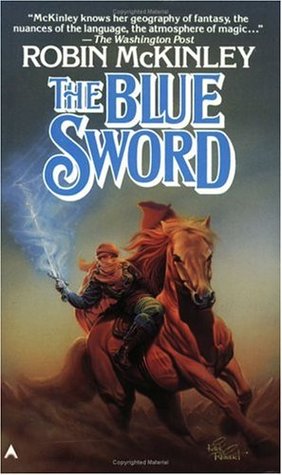
The Blue Sword

I discovered Robin McKinley when my dad read us her book The Outlaws of Sherwood, a pragmatic and slightly depressing retelling of the Robin Hood legend. I remember attempting to read a few of her other books and not falling in love with them really, until I read The Blue Sword

The Blue Sword is about a girl named Harry. That’s right - a girl. You love it already don’t you? I couldn’t tell you why her name is Harry, even though I’ve read the book several times. I think it is a nick name. Harry is forced to move to a new town when her father dies, a town that is essentially a military outpost and is on the edge of a vast desert, home to a strange and foreign people. Harry is inadvertently swept up in a war between these foreigners and their long-time enemies. 

Spoiler alert: She gets a blue sword.

If you’ve been reading my blog posts about the books I loved as a child, you will no doubt notice a theme when I say that I loved Harry because she wasn’t proper and well-behaved. She preferred horseback riding to sitting daintily in a parlor and not to give anything away, she kicks some pretty serious keister by the end of the book.

This book fits squarely in the fantasy genre and is technically young adult, but McKinley is a talented author, so it is young adult I think mainly because it doesn’t have cursing, sex, and violence or other mature content.


If you don’t love fantasy, you might not enjoy this book. It’s fairly traditional in it’s fantastical elements and plot. If you do love fantasy, you will enjoy McKinley’s world building and the development of Harry’s character.

Sunday, July 7, 2013

Saving the world through fiction

Welcome!
I am glad your internet travels have led you here to this humble blog. Perhaps your attention was arrested by the wildly catchy title of this blog post: "Saving the world through fiction." Perhaps you are thinking that is an absurd claim and you are about to navigate away from such silliness, but wait! If you give me a few minutes of your time, I will convince you that reading fiction is healthy, will improve your life and the lives of others around you, and might just SAVE THE WORLD.

I used to read for fun, when I was younger. My parents decided to make me a leper by giving away our television so I had nothing better to do with my time than read. It was one of the best decisions they ever made.

Reading transports you to a different world, similar to the way movies or TV shows do.  The difference, I believe, is that you learn to appreciate story when you read, whereas watching television without being an experienced reader is nothing more than vapid entertainment. Appreciating story means learning to empathize with a character, learning to put yourself in the setting of the book, learning to suspend disbelief and learning to imagine.

So when I was little, I read for fun. Then I went to college and I read for school. Then I took a break because I thought I didn't have time for reading and I hadn't yet realized how important it was. But one glorious day I picked up another book and by the time I had finished, I was wondering why I had ever stopped making time for reading. The difference between little me, reading for fun, and big me, reading as a grown up, was that I realized how powerful literature was. I wasn't reading for fun anymore - though it was fun - I was reading for other reasons. To escape. To understand. To imagine. To believe.


That is beautiful, you think, wiping away a tear, perhaps, at my touching commitment to literature, but it still doesn't explain how reading is healthy and can improve my life.

Well, alright. If you insist:
How can reading fiction be healthy?
It can be healthy because it taps into the emotions, offers consolation and joy, offers an outlet for stress, and helps you communicate with others about both the difficult and wonderful things in life. As Brian Viner points out in his article "Well Read," "words on a page can sometimes reach the parts the medical profession cannot." You can read that article here. It examines the non-profit initiative Get Into Reading (based in the UK) that is using literature as a form of group therapy for various troubled souls, including high-security psych ward patients.

How can reading fiction improve my life and the lives of others around me?
Reading teaches empathy. I have seen it in classrooms myself and heard many teachers talk about this phenomena. There was a recent study done that examined the connection between fiction and empathy, finally determining that reading fiction makes people more empathetic with others around them. Here is the link to another blog that also discusses this study. I don't think I need to state how much we could use more people who were more empathetic in the world.

There you have it. I'm sure you are smart enough to figure out that people who live healthier emotional lives and are more empathetic can make a very big difference in the world; it isn't too much of a stretch then (notice I said "too much") to believe that reading can, albeit indirectly, save the world.

Before I let you go, I must offer a disclaimer: I am not a doctor, I am not a therapist, and I am not trying to suggest that you read a book INSTEAD of seeking counseling if you feel that you need it. I am merely suggesting that fiction can improve your life and help you deal with reality. And I'm also suggesting that fiction makes the world a much better place to live in.

Now go get a book off the shelf, crack it open and feel the slide of the crisp pages between your fingers, contemplate the first page and the tantalizing hints that the title gives you about what might be contained in its pages. Then turn to chapter one...and start saving the world.